Saturday, June 02, 2018

Venice

While in Florence, we decided to spend a day in Venice. To avoid disappointment and to ensure a cheaper fare, we purchased the Florence - Venice train tickets a day in advance. Early next morning on 21 May 2018, we walked to the Florence Train Station from our accommodation to catch the high speed train - Trenitalia High Speed Rail.

Venice is known in many names - City of Water, City of Canals, Floating City, City of Bridges among others.

Waterbus or vaporetto is the only mean of public transport. However, not all opt to travel in this mode of transport. A common sight is to see overnight visitors trudging strenuously and simultaneously dragging their luggage along the alleyways to the hotels or back to the train station. The more well-off lots chose to hire potters to do the hard work.

Our visit to Venice in May coincided with the peak season when most of the popular sites were jam-packed with people. With an annual visitors count of 30 million, it would be a miracle for us not to be caught in long queues. But our policy has been to avoid attractions that needed long hours of queuing.
Public transport is by vaporetto, the waterbus.
It is said that one thing the locals never do is to take a ride of the gondola simply because they are considered way too expensive. Gondoliers are among the most well-paid people in Venice - earning around US$150,000 a year. Still, visitors appear undeterred by the price. We did not take the gondola. Instead, we chose to move around by walking along alleyways and hopped onto the waterbus when we decided to do a round cruise of the canal network.
************************************************
As we witnessed first hand, people who die here are not transported by hearse car. Instead the remains is transported by funeral boat or water hearse.
*************************************************
Stores selling Venetian masks are a common sight. Buying a Venetian mask is almost like buying a panda soft toy in Sichuan or a wakid in a local indigenous cultural centre in Sabah. We bought two tiny masks for our grandkids in Australia.
We crossed the Rialto Bridge to go to the Rialto Market. Unfortunately, it was closed by then.

A Glimpse of Florence

The historical centre of Florence is a city where visitors can be marveled and awed by the many historical buildings of magnificent design.

The Florence Cathedral or Duomo di Firenze is probably one of the most visited attractions in Florence. Since we were staying in an airbnb within walking to this building, I have lost count of the number of times I had to pass by this magnificent structure just to access to other attractions in Florence..

Formerly known as the Cathedral of Saint Mary of Flower, its shear size can best be appreciated from the sky. Its cupola is still the largest brick dome ever built, boasting an outer diameter of 54.8m (180ft) and an inner diameter of 45.5m (150ft). It is no wonder that it took 140 years to complete (1296 -1436).

The Baptistery of Saint John, an octagonal shaped building built just across the front entrance of the massive Florence Cathedral dwarfs in comparison.

We had wanted to go in to have a look at the interior of the Cathedral. But, a check with the counter confirmed that all tickets had been fully booked for the period when we were there. Even if we could purchase the tickets, the time consuming waiting in the massively long cue to enter would have deterred us anyway! The time would be better spent looking at other attractions nearby.
The Baptistery of Saint John
Just 500m west of Florence Cathedral and adjacent to the Railway Station is the Basilica of Santa Maria Novella, a Dominican Church completed in 1470.
*************************************************
It is probably not wrong to say that each great city has a river. Florence is no exception. River Arno which passes through Florence is the pride of Florentines and is equally their hazard. History records the flood on 4 November 1966 had caused the collapse of the river embankment resulting in at least 40 deaths and the damage of millions of works of arts and rare books.
Arno River.
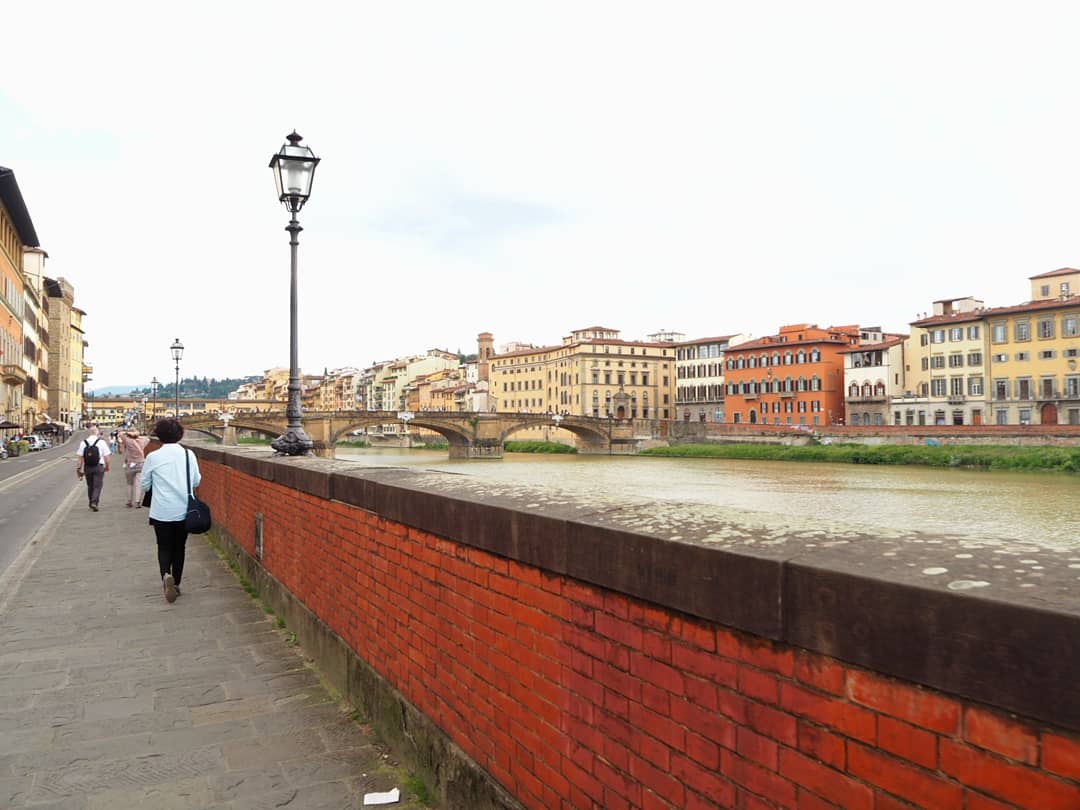
Walking alongside River Arno..
Another old bridge, Ponte Santa Trinita, an elliptic arch bridge is unique for the three flattened ellipses spanning across the river. The edge spans at both ends each measured 29m and the central span is 32m in length.
Ponte Santa Trinita or Santa Trinita Bridge 
at the background.
Ponte Santa Trinita.
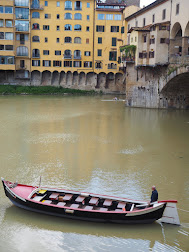
We walked to the west of Florence via the famous Ponte Vecchio, an old medieval stone bridge built across Arno River. The shops along the bridge once used by butchers are now outlets selling mainly jewelry and souvenirs.
Ponte Vecchio.
Jewelry shop along Ponte Vecchio.
Palazzo Pitti or Pitti Palace.

Museums & Galleries in Florence

A tour of Florence is incomplete without a visit to one of the many museums and galleries. After all, Italy boasts some of the most celebrated Renaissance artists and sculptors the world has ever had.

Initially, we had wanted to visit Galleri dell Accademia to see one of the most famous sculptures in the world - Statute of David by Michelangelo, a masterpiece of the Renaissance. We had planned to purchase the entrance tickets only upon arriving at Florence. As it turned out, tickets were all sold out throughout the period we were in Florence. 

But, there is no shortage of museums in Florence and a bit of effort would surely land you into one. Eventually, we found a less famous one to spend the late afternoon of 20 May. By the time we enter Museo Nazionale del Bargello or the National Museum of Bargello, it was past 4.00pm and just about an hour before it closed for the day.
Hall of National Museum of Bargello.
Left: Florence Triumphant over Pisa by Giambologna
Right: Baccus by Michelangelo Buonarroti
Brutus by Michelangelo Buonarroti.
*************************************************
In fact, Florence itself is an open museum. There are plenty of statutes and sculptures displayed in many prominent places for all to appreciate free of charge. Piazza dell Signoria or the Signoria Square is one ideal place where the public can view the outdoor art pieces for free. This was the main origin of Florence, both politic and culture. Many of the buildings date back to the 14th century.

At the southeast corner of Piazza dell Signoria is the Town Hall of Florence or Palazzo Vecchio.
Palazzo Vecchio, Town Hall of Florence - 
a 14th century building.
Just outside the entrance to Palazzo Vecchio - the life-sized replica of the "Statute of David" by Michelangelo at the left side and "Hercules and Cacus" by Bartolomeo Bandinelli at the right side.
***********************************************
At the south of Signoria Square and to the left of Palazzo Vecchio is the open-air sculpture gallery commonly referred to as Loggia del Lanzi.
Loggia del Lanzi.
The Rape of Polyxena by Pio Fedi.
Left: The Rape of the Sabine Women by Giambologna.
Right: Perseus with the Head of Madusa by Benvenuto Cellini