Saturday, May 04, 2013

Chapter 18: Primary Education

In the 1950s, there was no kindergartens. Formal education began with Primary One when a child turned six. Even before I reached that age, I eagerly longed to go to school. At just five years old, I would proudly carried a makeshift school bag filled with old papers and pages torn from calendars. My "classroom" was a quiet spot beneath a jackfruit tree, about 50m from our house. There, I would sit, flipping through the papers and examining the printed numbers on the calendar sheets. After my little ritual of pretend learning, I would pack up my things and head back home.
A typical jackfruit tree
In those days, children were enrolled in either a Chinese-medium or an English-medium primary school. My parents chose the Chinese school route for all their children. I began Primary One at Lok Yuk Chinese Primary School in 1958 when I turned six. At the time, the school was located on Signal Hill, where the Sabah Theological Seminary now stands. 

The school had six classes, one for each year from Primary One to Primary Six, with about 25 students per class. We sat two to a table, sharing a long wooden bench. Since it was a co-educational school, boys were allowed to sit with other boys - at least until Primary Three. That year, our female class teacher decided to change the sitting arrangement: each boy had to sit with a girl. We found this incredibly embarrassing. At that age, girls were like aliens to us - completely unappealing and strange! Some of us even drew dividing lines down the middle of our tables and the benches, warning our new seatmates never to cross them. A breach of that invisible boundary was nearly grounds for war.

The rule was finally lifted in Primary Six when the teacher allowed us to choose our own seats. It felt like a small but significant victory - a perfect way to end our primary school years.

Back then, private tuitions were practically unheard of. The only extra lessons offered were by the school itself, and only Primary Six during afternoons after lunch. This extra class was considered essential, as all Primary Six students had to sit for a government assessment examination in order to proceed to secondary school.

Primary Six was easily the most exciting year of my primary education. As the seniors of the school, we were looked up to as daiko and daije - big brothers and big sisters. The best part of the day was the break between the morning session and the start of afternoon tuition. During that window, we played all sorts of games. For the boys, "police and thieves" was a favourite. Those who played the thieves would hide in the most unexpected places - none better than the thick forest at the base of the hill below our school. 

Some boys were so masterful hiders that they weren't found even by the time classes resumed at 2.00pm. When they finally appeared at 2.15pm or later, they would walk sheepishly into the classroom knowing punishment awaited them. After a stern scolding, they would either be caned on the palm or, if lucky, made to stand for 20 minutes or more before being allowed to sit down again.

I'd be lying if I said that I was never punished. While I managed to avoid trouble most of the time, there was one memorable incident in Primary Six in 1963. Our male English teacher, a young bachelor, seemed particularly friendly with one of the girls in class. One day, I teased her by saying: "The English teacher loves you and wants to marry you!". She was so mortified by the comment that she burst into tear and reported me to our class teacher - who also happened to be the school principal. Needless to say, I was promptly caned on the palm a few times for my mischief.

The high point of my primary school years came in 1963, when North Borneo joined with Sarawak, Singapore and Malaya to form Malaysia. To mark the historic occasion, a grand lantern procession was held in Jesselton town (now Kota Kinabalu). Students from our school made a wide variety of lanterns, the most common being the five-pointed stars. The highlight, however, was a massive school project; a 40-foot-long lantern in the shape of a crocodile. It took about 25 students to carry it through the streets. A few of the stronger boys were assigned the most demanding task - operating the jaw of the crocodile, moving it up and down throughout the entire procession.
In retrospect, my primary school years remain some of the most cherished moments of my childhood.

Friday, May 03, 2013

It's Now or Never

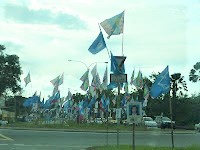
Never before, Malaysia has seen such determined desire of people of all creeds and ethnicities to see a total change in the way Malaysia is to be governed.

Every night, waves and waves of the battle cry: "Ini Kali Lah" reverberate in the ceramah put up by the opposition. Of course, the power of the day would resist being uprooted and resorted to all sorts of tricks either more goodies or even threats!
 
This time around,  I see an unprecedented number of young or first time voters who want to use their votes to initiate real change in Malaysia. They come back from overseers to exercise that right.
 
People are truly disgusted with the number one scourge in Malaysia: Corruption which has permeated into every level of the society. The perversion and abuses in the implementation of the so-called affirmative policy have driven scores of talents out of this country and benefitting many of our neighbours. In this era when every country including the Arab countries are yearning for better governments with inclusive policies. Sadly, Malaysia has regressed over the years. Many believe that if left unchecked, Malaysia will become a failed nation.
 
Every right thinking person would know that something is awfully wrong with our system of government when our neighbour's currency which was same as our some 50 years ago has risen sharply over the years and is now more than two and half time stronger than ours. This is especially unacceptable when our neighbours have no natural resources while ours is blessed with so many.
 
All well intentioned Malaysian genuinely hope that a new Malaysia will dawn after 5 May 2013!
 

Sunday, April 21, 2013

Chapter 17: Sungai Lembing and My Grandfather

Not long ago, my sister shared something surprising to me: according to our mother, our maternal grandfather had actually first gone to work in a mine in Malay before eventually coming to North Borneo (now known as Sabah) (Read here about my grandfather). My mother recalled that the mine he worked in was exceptional deep, though she couldn't recall its exact location.

When my wife heard this, she immediately suggested that the mine in question was likely the famous tin mine in Sungai Lembing.

Sungai Lembing is a historic mining town located about 40 Km northwest of Kuantan, in the state of Pahang, Peninsular Malaysia. A river runs through the town and eventually flows into the sea near Kuantan. According to the local Chinese accounts, the name "Sungai Lembing" (林明) originated from an Indonesian Chinese man, who upon discovering the area's rich tin deposits, decided to invest in mining operation there. 

Until 1970, Sungai Lembing was the largest tin producer in the world and was also known for having the deepest underground mine shaft globally (Read here).
Sungai Lembing: 3054’ 46.44”N, 1030 1’ 57.94”E
The British company Pahang Consolidated Company Limited (PCCL) was granted the rights to extract tin in 1891. Mining operations officially began in 1906 and continued until 1986, when global tin market collapsed. Tin was extracted through an extensive network of deep tunnels stretching a total of 322 Km, with shafts reaching depths of between 610 m (2,000 feet) and 700 m (2,300 feet).

In the early 20th century, PCCL went to southern China to recruit labourers, bringing in Chinese workers to work in the mines. I believe my grandfather was among those who made the journey. These early migrants likely arrived near Kuantan by sea and were then transported upriver by boat to reach the mining town of Sungai Lembing. 

At its peak, PCCL employed nearly 1,500 workers and provided housings, amenities, and even a cinema for its employees.

However, my grandfather did not remain in the mine for long. Unfortunately, the reason he left Sungai Lembing for North Borneo remains a mystery.

Since the closure of the mine in 1986, Sungai Lembing has steadily declined. Today, most of those who remain are elderly residents - descendants of the early Chinese miners. The younger generations have mostly relocated to larger towns and cities in search of better opportunities.

Despite this, Sungai Lembing still draws tourists. Many come to explore its remaining century-old buildings, the long suspension bridge, ancient trees, and to savor the town's well-known local dishes and delicacies.

Recently, Astro aired a documentary about this town, and I was fortunate to capture some of the old photographs that were featured in the program.
**************************************************
I hope to visit Sungai Lembing in the not-too-distant future - to explore its historic charms and sample some of the much-talked-about local dishes and delicacies. Who knows, I might even be fortunate enough to uncover a piece of my grandfather's story while I'm there!
**************************************************
Sungai Lembing yong tau fu. Traditionally made using fresh stream water sourced from pristine untouched jungle.
Century-old tree (百年老樹): Then and now.

Suspension Bridge.

Wednesday, April 17, 2013

Chapter 16: My Uncle - A Controversial Man

My uncle, the only sibling my mother had, was born in 1930 - two years after her. In their native village of Kampong Pulutan, he was better known by his nickname "Ah Tai", rather than by his given Chinese name, Yee Tshan Fah.

15.11.1930 - 7.9.1992
He must have been a well-behaved boy in his youth, judging by the kind words we heard from Aunty Stelli Benggon when we visited her in early February this year. They had grown up together in the same village.

He was of medium height, slightly plump, with a noticeably high forehead. His presence was unmistakable - he spoke in a loud, commanding voice that drew attention wherever he went. As a child of mixed parentage, he was often referred to as the "eleven o'clock kid" (十一點), a common term used at that time to describe people of mixed heritage. His wife was also of similar background. In early years, he was a devoted husband, a loving father and a respectful son. He worked diligently as a carpenter to support a large family: his mother, his wife and their eight children. Together, they lived in a spacious bamboo house in Kampong Pulutan.
Marriage photo with the 1st wife.

One of my fondest memories of him was from a school holiday visit to his house. I was probably around eight years old at the time. He took time off from work and crafted three wooden tops - two slightly taller ones for my older brothers and a smaller one just for me. What struck me most was he didn't make any for his own children then, choosing to focus on us. Thanks to his skills, and the special tools ha had as a carpenter, the tops were beautifully made - smooth, balance, and far better than any store-bought. When we played with them, the admiring, envious looks from the neighbourhood boys made us incredibly proud. Those simple toys became treasured gifts, and they left a lasting impression on me.
Typical top.

His reputation as a skilled carpenter grew steadily, and soon his services were in high demand. Contractors began calling on him for projects farther and farther from home. I remember him telling us excitedly about one such assignment - he had to spend several weeks at Mt Kinabalu, helping to build the transmitting tower there. He was full of pride and enthusiasm as he described the thrill of travelling daily in a cable-suspended gondola from the foothills up to the work site nestled along the mountain slope.

These outstation assignments, marked a turning point in his life. Rumors of his growing fondness for women began to spread. He returned home less and less, and his financial support to his family became increasingly sporadic. Both his wife and his mother tried to steer him back - sometimes with kind words, other time with scolding - but their efforts were in vain. I recall my own mother being asked by my grandmother to speak to him, even to reprimand him if needed. She did, but that too had no lasting effect.

Eventually, his wife left him, and his eight children were left in the care of my grandmother. Sadly, most of them were unable to complete their education, a consequence of financial hardship and the lack of proper parental guidance.

Beyond his first wife, my uncle was involved with at least four other women, all of whom bore him children. One was a divorcee, and others were unmarried. Contrary to the common perception of such women, they were not home wreckers. I came to know at least one of them quite well - his second wife, the divorcee with two daughters from a previous marriage. She turned out to be a kind and gentle woman, who, over time, was accepted and and even liked by my mother and other relatives.

Another relationship involved one of his workers, a Kadazan lady who later gave birth to a daughter named Alice Yee. In an odd twist of faith, Alice would later become a schoolmate of my daughter, Serene, at SM St. Francis Convent. The irony was not lost on us - my daughter and her aunt sharing the same school. Sadly my uncle never fully embraced his paternal responsibilities with these additional children, leaving many of them and their mothers to fend for themselves.

Despite his philandering ways and his tendency to neglect his role as a father, many people who knew him still spoke fondly of him. They remembered his generosity and his willingness to help. My uncle, Hj. Mandamin once told me that he learned carpentry while working under him. That skill later enabled him to start his own contracting business. He remained grateful for the opportunity my uncle had given him. Similarly, Uncle Wesley Pai recalled his time working as one of his workmen. He too picked up his carpentry skills, which he eventually used to build the very house where he now lives in. Uncle Wesley also remembered how "Ah Tai" had supported his education, allowing him to secure a job as a clerk in the National Registration Office.

To me, my uncle holds a special place in my memory. He was, in fact my first boss (Read here). I worked for him during a school break when I was 15 years old.

In the later years of his life, my uncle continued to work as a contractor, specializing in graveyard construction and tombstone restoration. He remained active in this line of work almost until the end. In his late fifties, he began to suffer from high blood pressure and declining health. He passed away in September 1992 at the age of 62 and was laid to rest beside his parents in the Roman Catholic Church Cemetery at Mile 1.5, Jalan Tuaran.

Monday, April 15, 2013

Chapter 15: Fun Games and Happy Times in the Village

School holidays were the most eagerly anticipated time of the year for the children in the village. It was a welcome break from early mornings, daily homework, and school tests.  During this period, kids enjoyed a sense of freedom, even though they still had to help with the usual chores assigned by parents and elders.

Despite these responsibilities, the holidays were filled with excitement and creativity. The children always found new and imaginative ways to entertain themselves, coming up with games that sparked joy and friendly competition. Some of the most popular games we played included marbles, the rubber bands game, rope jumping, the seven-pebble game, the two-stick game, top spinning, stilts walking, tin can stilts, the "aeroplane" jumping game (飛機), and the classic police-and-thief chase.
Sometimes, we would explore the streams and creeks in search of small fish, shrimps and crabs.  If we wanted to catch larger fish like snakeheads or catfish, we'd head to the ponds with our homemade fishing rods, crafted from simple sticks and lines.

One of the boys' favourite pastimes was kite flying. The most popular spot was the hill where the Istana (the governor's house) now stands. Back then, the hill had just been levelled and offered an ideal location - wide open, free of obstructions, and constantly swept by strong winds.

What made the kite flying especially thrilling was the friendly "combat" that took place in the sky. We would coat the kite strings with glue mixed with finely ground glass, turning them into cutting threads. The goal was to maneuver your kite close to an opponent's and try to "saw" their string mid-air. A neighbourhood boy nicknamed “Ah Yiam”, was notorious for his aggressive style. The moment we saw him making a move, we'd dash away to avoid having our kites mercilessly cut down.
*************************************************
Another popular game among the boys was competing to see who had the hardest rubber seed. The fun began with a search through the rubber trees estate for fallen seeds. Once everyone had collected their best find, we paired off to determine who would take the first strike in the contest.

In each round, the winner of a coin toss (or similar method) would place their seed on top of their opponent's and deliver a firm blow. The goal was to crack the seed underneath - but the outcome wasn't always predictable. Sometimes the seed on the bottom turned out to be tougher and shattered the one on top instead.

The elimination-style competition continued until only one unbroken seed remained. Its owner would be crowned the champion. Like a victorious cockfight contender, he would proudly treasure his winning seed, often storing it in a special container as though it were a priceless gem!
Of course, not all happy times ended on a high note. Every now and then, when we got too carried away and lost track of time - or forgot our responsibilities, like bringing in the laundry before it got soaked by the rain - we knew there would be consequences waiting at home. Punishments often in the form of caning with a rotan or a smack from the waist belt, were not uncommon.

Still, despite those occasional harsh lessons, growing up in the village was an unforgettable and joyful experience.

Sunday, April 14, 2013

Chapter 14: Money Mattered

Providing enough food for the family was a constant concern for my parents. In those days, my father worked as a tailor, but there was no such thing as a statutory minimum wage. His income depended entirely on how many trousers or shirts he could complete in a given month. Supporting a household of eight - my parents, grandfather and five boys before my youngest sister was born - was a monthly challenge.
 
The pressure intensified when all the boys began attending school. To make ends meet, my parents had to take on additional work. Every morning, after preparing breakfast for us, they would hurry off to tap rubber at a nearby plantation. Once the trees were tapped, my father would rush home, wash up, and head out on his bicycle to begin his tailoring work for the day. 

My mother, meanwhile, stayed behind to complete the remaining tasks - Collecting the latex, straining the milk, adding chemicals to trigger coagulation, and finally rolling the rubber into sheets. By the time she returned home in late morning, it was already time to cook lunch for the boys returning from school. 

On weekends, we children also helped out with the rubber tapping. Although we weren't allowed to perform the delicate task of shaving a thin layer of bark in a downward spiral using the sharp tapping knife, we were entrusted with collecting latex and other lighter duties. We would wrap up the day once the rubber sheets were rolled and hung out to dry.
*****************************************************
At times, my mother took on odd jobs as housekeeper for expatriates living nearby in the government quarters. Back then, the British colonial government often built these residences on Signal Hill, which offered sweeping view of the South China Sea.
 
My father, on the other hand, seemed to work tirelessly -  almost 24/7. Every evening after dinner, he would immediately return to his tailoring, working on items brought home from the shop or fulfilling orders from friends and acquaintances. Both of my parents worked incredibly hard to keep the family going.
 
Even as a young boy, I understood the importance of earning extra money. I took on my first job at the age of 15, while I was in Form II. My uncle - my mother's brother, Yee Tshan Fah - hired me as a helper during the school holidays. At the time, he was a contractor involved in the construction and restoration of graves and tombstones at local cemeteries. My main task was to trace Chinese characters or calligraphy onto the tombstones and later painted them with gold paint. I was paid four dollars a day. 

I remember many occasions when I was left alone in the cemetery during lunch breaks when my uncle went out to buy food. Oddly enough, I often found myself napping atop covered burial chambers - and I wasn't the least bit afraid!

After completing my A-Level Upper Six at Sabah College, I worked as a trainee draftsman in the Structural Section of the Public Work Department (PWD) for nearly a year and a half, from early 1972 until March 1973. I left the job to pursue a degree in Civil Engineering at the University of Malaya.

P/S: Looking back, one of the most satisfying moments in my life came years later, when some of the expatriates my mother once worked for became my colleagues. Between 1978 and 1984, while I was serving as an engineer on the KK International Airport development project, one of those expatriates - now a mechanical & electrical consulting engineer - was assigned to the same project. It felt like life had come full circle!

Chapter 13: My First Home

I grew up in a small house built on a rented plot of land along Harrington Road (now known as Jalan Istana). My father had the house constructed after moving to Jesselton from Beaufort, shortly after marrying my mother. At the time, the rent for the land was 8 dollars a month.
 
The house was modest in both design and size, built in a typical rectangular layout. A single bedroom measuring approximately 12 feet by 15 feet, occupied one end of the house. Next to it was the living room, slightly larger at approximately 15 feet by 15 feet. The walls were made of 6-inch-wide, 3/4-inch-thick timber planks nailed vertically side by side. The flooring was also timber. Separating the bedroom from the living room was a simple cloth curtain, a common substitute for doors in those days. 

Beyond the living area was the kitchen-cum-dining space, built about five steps lower than the main floor. The kitchen had a bare dirt floor and was adjacent to a small enclosed bathroom. The entire house was topped with an attap roof.

Just outside, about four feet from the bedroom end of the house, stood a detached hut measuring 10 feet by 10 feet. This was occupied by my paternal grandfather.
 
Our home had no electricity, no piped water, and no gas stove. Water was "piped" from a nearby creek using split bamboo channels that carried water directly to the bathroom. The water flowed continuously into a metal tank, which had originally been used to store petrol or diesel. However, during dry spell, the creek would run dry. When that happened, we had to dig into the creek bed to tap into underground water. But since the water level was lower than the house, it couldn't flow through the bamboo duct. We had to manually fetch it using buckets suspended from both ends of a wooden pole balanced on our shoulders.

There were times when digging into the creek bed yielded no water. In such cases, we had to walk more than a kilometre to find alternative sources - usually deep wells located at the foot of nearby hills. Because carrying water from such distances was exhausting, we often took our dirty laundry with us to do the washing and bathing at the source itself. Only a small amount of water - just enough for cooking and drinking - was brought back to the house in buckets.
***************************************************
Lighting in the house was limited and only available from around 6pm to 10pm each evening. Our sole source of illumination was a kerosene lantern, lit at dusk and hung in an opening between the living room and the kitchen. By its glow, the children would gather around the dining table to complete their homework shortly after dinner. In another corner of the living room stood the sewing machine, where my father would sit and do extra tailoring work to earn a little more and help supplement the family income. 

The lantern remained lit until my father decided it was time to sleep - usually around 10pm - at which time it was extinguished. In the bedroom, a dim kerosene lamp provided minimal lighting. With no entertainment options liked a radio or television, the children were typically in bed well before the night drew to a close.
***************************************************
Firewood was the only source of fuel we used for cooking and boiling water. I remember that one of the main tasks during the school breaks was gathering firewood from the nearby hill. We had to collect enough to last for 2 to 3 months, which was no easy task. First, we chopped down sizable trees and trimmed off any unwanted branches and leaves. Then, came the hard part - dragging or carrying the logs back to the home compound. Once there, we cut them into 2-foot lengths and split them into smaller pieces using a parang or an axe. After allowing them to dry thoroughly, we stacked them neatly in preparation for use.
***************************************************
As the years went by and my younger brothers and sister joined the family, an additional room was built at the back of the house to accommodate our growing household. I lived in this house for over 21 years until we finally moved to a new place in 1972. One thing that stands out most in my memory is the complete absence of theft or break-ins. We could leave the house with the door unlocked, and the whole family could be out without a worry. Those were truly different times!