Wednesday, September 17, 2014

Stonehenge

We drove to Stonehenge from Oxford, making a stop there on our way to Bathampton. Located in Wiltshire, approximately eight miles north of Salisbury, Stonehenge is one of the most iconic and mysterious prehistoric monuments in the world.

The earliest phase of Stonehenge dates back around 5,000 years, when it served as a burial site for cremated remains. Around 2,500 BC, the monument underwent a major transformation with the erection of its famous standing stones. Two distinct types of stones were used: the massive Sarsens and the smaller Bluestones. The Sarsen stones, weighing between 20 and 30 tons each, were arranged in two main patterns - an outer circular ring and an inner horseshoe formation. Between these were positioned the Bluestones in a double arc.

It is truly mind-boggling to contemplate how prehistoric people managed to transport and erect such colossal monoliths without modern machinery. The Sarsens were quarried from Marlborough Downs, about 20 miles north of Stonehenge, while the Bluestones - each weighing up to 4 tons - were believed to have been sourced from the Preseli Hills in Wales. Archaeologists suggest that the Bluestones were transported by a combination of sea and river routes along the Welsh coast, followed by an overland journey to the site.

The entire process - from quarrying to transportation and final erection - was achieved solely through human ingenuity and determination. Stonehenge stands not just as an archaeological wonder, but as a testament to the skill, strength, and vision of ancient civilizations.

                                                                                 Photo: Courtesy from website.

Tuesday, September 16, 2014

Oxford

Immediately upon reaching Oxford from London on 15 August 2014, we boarded the double-decker bus to tour this city. Through the audio aid, we were fed with a fair amount of information about this university town.

There are over 22,000 students, 11,770 undergraduates and 9,850 graduate students. 62% of graduate students come from outside UK. Academic staff come from almost 100 different countries and students from more than 140 countries.

With the short time allowed for the visit of Oxford, we did not manage to enter any of the university buildings.
Though we may have the impression that many of the exceptional and brilliant students are Asians and Chinese, the actual enrollment of both Asians and Chinese is in fact just over 2% of the total intake.
 
For Harry Potter's fans, it was said that many of the movie scenes were shot in this University. The Great Hall of Christ Church College was quoted as one of the locations. But in actual fact, the filming wasn't done in the Great Hall at Christ Church. The hall was copied and rebuilt as a set, but it looks as identical (as one would expect from the art director team).

The Greenwich Meridian

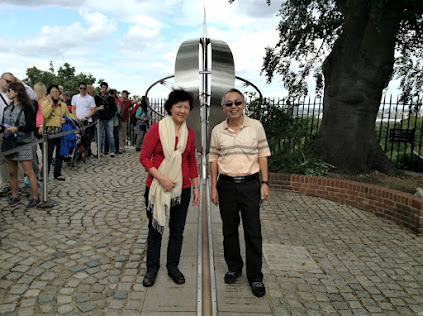
On 13 August 2014, I stood at the Greenwich Meridian, with one foot in the Eastern Hemisphere and the other in the Western - straddling the very line that divides the world longitudinally.

This Zero Degree Longitude, established at the Royal Observatory in Greenwich, England, was defined by Sir George Airy in 1851. However, it wasn’t until the International Meridian Conference held in Washington D.C. in 1884 that the Greenwich Meridian was officially recognized as the Prime Meridian of the world. At that conference, 22 nations agreed to adopt it as the global reference point for timekeeping and navigation.

Although the Greenwich Meridian is an imaginary line, it plays a critical role in geography and global coordination. In addition to the United Kingdom, it also passes through seven other countries: France, Spain, Algeria, Mali, Burkina Faso, Togo, and Ghana.

Kota Kinabalu, located at approximately 116.0782 degrees east longitude, should theoretically be 7 hours and 45 minutes ahead of London based on its geographical position. However, for the sake of national consistency, Malaysia has standardized its time zone to be exactly 7 hours ahead of London’s time (GMT+8), simplifying coordination across the country.

 
It costs 7 pounds to stand on this line within the fenced compound.
However, visitors can also choose to have photo taken free of charge next to a vertical line outside the fenced compound. We did both.

Sunday, September 14, 2014

Gardens and Parks in London

London, a city of 13 million people has an area of almost 1,600 Square Kilometres. This is 40 Km x 40 Km Square. In spite of its dense population, the city has plenty of open spaces for people to enjoy and relax. I suppose that is what make London such a great and unique place to visit.

Kensington Gardens
This vast open space covering an area of 111 Ha (270 Ac) used to be a private Royal Garden. Walking and riding a bike within the network of the sealed tracks was indeed a pleasant experience.
************************************************************
St. James Park
We passed through St. James Park after visiting Buckingham Palace on the way to visit the Churchill War Rooms. This Park is comparatively smaller than either the Hyde Park or the Kensington Gardens. Still with an area of 23 Ha (57 Ac), there is still plenty of nature and wild lives for people to enjoy.

The British Royal Institution

Buckingham Palace
In 2013, British taxpayers contributed over £35 million towards the upkeep of the royal monarchy - a figure that continues to spark debate among citizens. The question, "Is the British Royal Family worth the money?" is one that has often been asked. However, with an estimated £500 million generated annually through tourism associated with the Royal Family, many still argue in favour of its continued presence and relevance.

A key attraction is Buckingham Palace, the official residence and administrative headquarters of the monarch. Open to the public for around 60 days each year - typically during August and September - the palace draws large crowds. In the previous year alone, approximately 600,000 tourists paid to step inside this iconic royal residence.

In 2014, the Palace was open to the public from 2 August to 28 September. I was among the many who seized the opportunity to visit and experience the grandeur firsthand.

Buckingham Palace is as much a working institution as it is a historic landmark. It houses an impressive 775 rooms, including 19 opulent State Rooms, 52 Royal and guest bedrooms, 188 staff bedrooms, 92 offices, and 78 bathrooms. The building spans over 77,000 sq. m from basement to rooftop - a staggering space that demands meticulous care.

The palace contains 1,514 doors and 760 windows - all of which are cleaned every six weeks to maintain their immaculate condition. Inside, more than 40,000 light bulbs illuminate the rooms, and over 300 clocks and watches form one of the largest collections of functioning timepieces in the world. These are diligently maintained by two full-time horological conservators who wind them weekly and ensure their precision.

With such scale and detail, it’s no surprise that close to 500 staff are employed to keep the palace running smoothly - a reflection of the immense logistical operation behind the glamour.

Our first attempt to witness the Changing of the Guard on 11 August 2014 was thwarted by the sheer size of the crowd. Arriving slightly too late, we found ourselves far from the palace gates and were only able to catch a distant glimpse of the ceremony.

Determined not to miss our main visit, we returned the following day, arriving well before our scheduled 4:30 p.m. admission time. Joining the queue with fellow visitors, we waited eagerly for our turn to step inside one of the most recognized residences in the world. 

We could not see the actual Change of Guards. Instead, we could flip through the Magazine extended to us to have a feel of the ceremony.
All visitors have to exit from the rear of the Palace after the tour.
*********************************************************
Kensington Palace
Part of Kensington Palace has been opened to the public in recent years - a move that likely reflects the Royal Family’s efforts to generate additional income and promote greater public engagement with their historic residences.

Located in central London, Kensington Palace remains an official residence of the British Royal Family. Among its most well-known current occupants are Prince William and Catherine, the Princess of Wales (formerly Duchess of Cambridge). The palace also houses several other senior royals, including Prince Harry, Prince Richard, Duke of Gloucester (youngest grandson of King George V and Queen Mary), and his wife, Brigitte, Duchess of Gloucester. Other residents include Prince Edward, Duke of Kent, and his wife, Katharine, Duchess of Kent, as well as Prince Michael of Kent (another grandson of King George V) and his wife, Marie Christine.

Kensington Palace also holds great historical significance, having once been the home of Prince Charles and Princess Diana during their marriage. It was here that Princess Diana lived and raised her sons, Prince William and Prince Harry, and where many of the public’s lasting memories of her are rooted.

Front and rear of Kensington Palace.
***********************************************************
Aside from Prince William and Prince Harry, another prominent royal figure is Prince Edward, who is often recognized for his regular appearances at the annual Wimbledon Tennis Tournament.

Saturday, September 13, 2014

Salted Beef Burger

We were forewarned - or perhaps tempted - by Sam to try the salted beef burger along Brick Lane in London. With nothing more than this vague recommendation, Alicia gamely took the lead in our culinary quest to track down the elusive outlet that served this specialty.

We took the Underground and alighted at Whitechapel Station. Upon exiting, we instinctively turned left along Whitechapel Road. After walking about 500 m, Alicia asked a passerby for directions, only to find out that Brick Lane was actually in the opposite direction. So, we made a full 180-degree turn and started trudging back the other way. Still, even after walking another 1.5 Km, Brick Lane remained elusive - until finally, the familiar street sign appeared like a long-awaited beacon.

Turning into this so-called “lane,” we were surprised to discover that Brick Lane was not a short alley, but a long and winding road nearly 1.5 Km in length. We walked... and walked... and walked. Our legs were beginning to feel like tau foo - soft and wobbly - when at last, we spotted the signboard of the famous "Beigel Shop," proudly proclaiming itself as “Britain’s First & Best.”

Initially, we assumed there would be seating available to enjoy our long-sought-after burgers. Alas, the shop was strictly takeaway - no dine-in option. So, with bags in hand and feet too tired to go any further, we hailed a cab and headed back to the hotel.

Only later, in the comfort of the hotel’s common lounge, did we finally sit down to savour the burgers that had cost us so much sweat and perseverance.

To be perfectly honest, I wasn’t a fan of the chewy texture of the bread bun. The salted beef, while clearly natural and generously portioned, tasted surprisingly similar to tinned corned beef - slightly underwhelming after such a long trek.

When Sam found out which shop we had bought the burgers from, his immediate reaction was, “Alamak! Wrong Beigel shop!” It turned out the one he had in mind all along was actually Beigel Bake, not Beigel Shop. All that walking - and we had ended up at the wrong place!
The very next day, while exploring a food court near London Bridge - just beside Southwark Cathedral - we stumbled upon a stall selling the same salted beef burger, also originally from Brick Lane. Imagine our surprise! So, for fellow salted beef burger enthusiasts, take note: there’s no need to walk the length of Brick Lane like we did. Simply head to this convenient outlet next to Southwark Cathedral, especially if you're already planning a visit to Tower Bridge. Your feet will thank you!