Saturday, May 10, 2014

Moments with Grandchildren

After coming back from a recent trip to Perth, KK is liked a torture chamber because of the exceptional hot weather. Literally 36 degrees C everyday.

Spending time with our fast growing up grandchildren is always a welcome break. Knowing the special bond the grandparents have with them, they know how to take full "advantage" of the presence of their grandparents. The most frequent request of Nathan to the gung-gung or po-po was: Asked to be carried. Of course, he would not be disappointed at most occasions. Though technology has enabled grandparents to communicate with the grandchildren via Skype, it is still a very different experience to be able to feel and hug each other.
*********************************************************
Grace is growing at a phenomenal speed. By the time I left Perth, Grace was able to stand unaided for at least 3-4 seconds.

Nathan is maturing fast into a young boy. One of the things I am most impressed is his ability to verbally express his feeling - sad, happy or felt loved. This is truly a quality rare among most people.
**********************************************************
"This is persimmon!"

Nathan is maturing fast into a young boy. One of the things I am most impressed is his ability to verbally express his feeling - sad, happy or felt loved. This is truly a quality rare among most people.
*******************************************************
It was a feeling of endless happiness when Grace responded and crawled towards gung-gung and po-po whenever she sensed the signal for her to come. Indeed, grandchildren are God's way of compensating us for growing old.

Friday, April 18, 2014

In Memoriam of Kapal Singh 1940 - 2014

17 April 2014, a very sad day for Malaysia when veteran politician, Kapal Singh died in a car crash on the way to a court hearing in Penang.
 
A true champion of human right, justice and equality. His passing would be felt by all fair-minded Malaysians for a very very long time to come.
 
"As long as I am alive, I will continue to struggle to see a non-Malay become prime minister" - Kapal said this in 2012 that the Federal Constitution did not provide that only Malays could be prime minister. Unfortunately, he did not live to see this becoming a reality.
 
"They want to make it as difficult as they can for us here so we'll go away. But we will not go - that would be giving them what they want, and that would be wrong. We have to stay and fight". Kapal said this in an interview with an online news portal in 2014, discussing his guilty verdict on the charge of sedition

Sunday, April 13, 2014

Parenting

Following the successful Marriage Enrichment Course held in October last year (Read here), the Church launched a Parenting Course in April 2014.

Parenting courses have emerged in response to growing concerns over child development, rising family stress, and the challenges brought about by changing social dynamics. The Church recognizes that as societies become more complex and traditional support systems - such as extended families - continue to weaken, many parents are left without adequate guidance to navigate the demands of modern parenting.

Research in psychology and education consistently highlights the vital role parenting plays in shaping a child’s emotional, social, and cognitive development. Increasing rates of behavioral problems, academic difficulties, and mental health issues among children further underscore the need to support parents. In response, professionals in child development, education, and social work have developed structured, evidence-based parenting programs designed to equip parents with the knowledge and skills to raise confident, resilient, and well-adjusted children.

In addition to parents, the Church also encouraged members involved in the children’s Sunday School ministry to participate in the course. 

Interestingly, the majority of attendees were still women - especially mothers - reflecting the ongoing need to involve more fathers and men in parenting and child development efforts.

"The graduates".
Gift package for each "graduate".

Saturday, April 12, 2014

New Kota Kinabalu Coastal Pedestrian Walkway and Cycleway

Phase 1 of the Kota Kinabalu Coastal Pedestrian Walkway and Cycleway is finally completed and opened for public use. This is indeed a great facility that allows city dwellers to walk and cycle along this trail to enjoy the scenic coastline.

The many picnic spots are ideal for families who wish to spend a weekend together. For cycling enthusiasts, a cycling trip along the trail as a family would sure yield lasting memories.

Recently, we drove along this coastal highway and stopped to take a few shots of this newly completed trail. Phase 1 trail which is just 5.2 Km starts from the Sabah Port and ends at Likas Bay. According to City Hall, the final trail will be 25.6 Km long stretching from Tanjong Aru Town, passing KK Central Business District and ending at University Malaysia Sabah.
 
From Likas Bay in the evening, one can have this stunning view of part of KK city.

Saturday, April 05, 2014

Working Visit to Singapore

Our recent trip to Singapore was more a "working visit" rather than a sight seeing tour. As the boys hardly have the chance to eat home-cooked food, it was the idea of their mom to "bring" herself - the home chef to Singapore to do the job on the spot.
Of course in Singapore, no one would visit the place without tasting some of the many many food that the place can offer. We had a chance to eat the bean sprouts chicken rice which we last ate in Ipoh (read here). I must say that it was authentic and similar to what I had in Ipoh.
At Ya Kun Kaya Toast, I reminisced the old days when I followed my grandfather to the coffee shop. Normally, one cup was ordered. I had to drink from the saucer while my grandfather would drink from the cup!

Wednesday, April 02, 2014

It Was as if We have Met Before.........

Sam was keen for us to meet up with the Chong's - Rachel's parents. So, when we decided to have a short visit to Singapore in late March, Sam was quick to arrange a meet up in a casual and pleasant environment - Wah Lok Cantonese Restaurant of Carlton Hotel.
 
We chatted almost non-stop the moment we met. It was as if we have known each other for years. One thing for sure, we did learn something from their significant travelling experience.
 
We look forward to our next meeting up again!
 

***********************************************
 
Quite to my surprise, CHIJMES is just next to the Carlton. The unexpected visit gave us a good feel of the majesty and ambiance of this historical building - a popular place for couples to have their wedding ceremony.
 
 
The long aisle is ideal for bridal march. Hopefully, if Nathan is given the honour to be the Page Boy, he will dutifully complete the long march!
 

****************************************

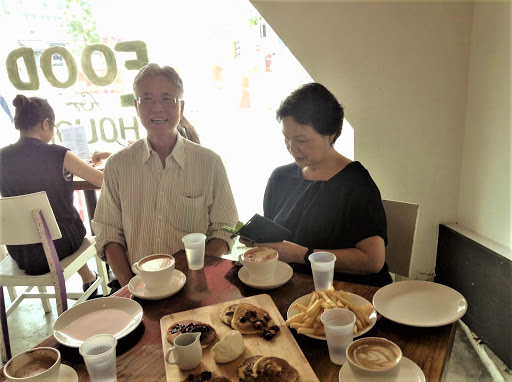
We finally adjourned to "Food for Thought @ 8 Queens Street" which is also at walking distance from Chijmes - the cafe where Sam put his barista skill to practice. Coffee and the unique pancakes were great! Thanks Sam for a great weekend.

Sunday, March 23, 2014

Disappearance of MAS Flight MH370 - An Isolated Case?

 
The deficient quality of the top leadership of Malaysia civil service has been glaringly exposed to the whole world through the unfortunate incident of the disappearance of MAS flight MH370. After 50 years of a blotched education policy, we now have a generation who can hardly speak and convey message to the world audience. Sadly, we have come to a phase of the blind leading the blind.
 
In the latest missing flight saga, we have read of one Malaysian senior official who said something like ".......we have carried out an expensive exercise" in one of the news briefings followed quickly by a correction of "..............we have carried out an extensive exercise".

Now, the government mouth piece is using the often-quoted words of "The missing MH370 flight is an isolated incident" to defend the handling of the case by their master.

 
The phrase "This is an isolated incident" is one of the many favoured statements used by either the government politicians or their mouth piece to defend their master. The sad thing is that even after two foreigners managed to enter the plane using stolen passports without being detected, they still insisted that their personnel had followed the standard operating procedures (SOP)!

When a group of Filipino armed rebels from Tawi-Tawi in southern Philippines entered Felda Sahabat 17, Kampung Tanduo in Lahad Datu in February 2013, certain official of the Malaysian security department used the "This is an isolated incident" to defend the handling of the case by Malaysian government.

When armed men made their way to a resort in Pulau Pom Pom in Semporna and shot dead a Taiwanese tourist before kidnapping his wife in November 2013, the phrase "This is an isolated incident" was again heard.

This is undeniably a phrase that was used more than it should be used. But then, we are famous for using ambiguous terms to defend what otherwise is an obvious case of deficient and inefficient governance Read Here.

One wonders whether we need ten more MAS planes to disappear before the authorities deemed serious enough to take pre-emptive actions?

Thursday, March 20, 2014

Closure of the Tragedy of Flight MH370 ?

 
The mysterious disappearance of Malaysia Airlines MH 370 from KL to Beijing on 8 March 2014 has propelled Malaysia to an unprecedented world attention. The purported twists and turns of the plane after the shut down of the transponder at 01:19am were puzzling and have generated all sorts of conspiracy theories. Whether by divine intervention or mere imagination, I had a most unusual dream last night. Here is the dream........
 
 
The pilot Captain Zaharie Ahmad Shah was known to be an avid flyer and had set up a flight simulator to hone his flying skill. It was said that if he was not flying Boeing 777, he would be flying toy plane or playing with other remote control aircraft. With some of the information gleaned in the flight simulation, he was keen to try out the capability of Boeing 777 beyond its permitted limit, i.e to check its performance at an altitude of 45,000 ft.
 
Not long after the plane took off at 00:41am, he broached the idea of testing the plane's capability to his co-pilot Fariq Abdul Hamid. The co-pilot initially objected but was convinced by his senior to give it a trial. After all,  the co-pilot was no match to his senior who had 18,365 flight hours experience compared to his of only 2,700 flight hours. They reckoned that the best time to do the maneuver was at the transition when air traffic control was shifted from Malaysia to Vietnam.
 
It started with switching off the ACARS system at 01:07am, Just before setting the trial in motion, the co-pilot said "All right, good night" at 01:19am to assure all those manning the air traffic control everything was in order. At 01:21, the transponder was switched off so that the "unusual movement" could not be monitored. After some re-programming, the plane changed course and climbed to 45,000 ft from 35,000 ft. Suddenly at this height, something unexpected happened, the depressurization at the passenger section caused practically instant death to everyone there due to asphyxiation. It was so sudden that none of the passengers had the time to make any call via their hand phones. Realizing the problem in hand, the pilot made an instant rapid descend hoping that the disaster could be averted. Unfortunately, it was too late.
 
By then the plane was at 23,000 ft, the pilot and co-pilot were in a state of shock. After some discussion, they decided to return to KLIA. But then immediately, they aborted this plan because they just could not bear to see the consequences of landing a plane carrying two hundred plus of dead bodies. That would be catastrophic to both the Malaysia Airlines and the Malaysia government.They knew that their own lives would be finished.
 
Confused and without a way out, they decided to fly the plane to the deep Indian Ocean. When the fuel was all used up, the pilot then guided the plane slowly down onto the ocean with minimum damage. The pilot then opened the cockpit door, water came in and filled up the compartment and the plane sank slowly to the bottom of the ocean. It was their way of concealing the truth so that this accidental mass murder would never be known...........

This afternoon, the breaking news was that credible debris at the Indian Ocean approx. 1,400 miles west of Perth have been sighted by the satellites.

It is my hope that my dream was not the actual case related to the disappearance of the plane. This theory in my dream hopefully may be a good Hollywood material and one day become a box office success!

Wednesday, February 26, 2014

Chapter 24: Jobs I did

Promotional material is a rare sight in our housing estate. So it caught my attention when I spotted an advertisement yesterday - it was for a home tuition teacher offering to conduct lessons at the student's residence. 

In an age where tuition centers are sprouting up everywhere - often requiring parents or carergivers to handle drop-offs and pick-ups - this personalized, at-home option might be quite appealing to some!
In my younger days, I took on a variety of jobs. One of them - working as an odd-job labourer in graveyard construction and tombstone restoration - is detailed in Chapter 14. I also worked as a part-time tuition teacher while I was an A-Level student, and continued doing so during the post-A Level period before entering university. Those were all part-time, taken up to earn extra pocket money.

I provided one-to-one tuition at students' homes and also coached small groups. Since I didn't have a tuition centre of my own - and my old house wasn't suitable for such a purpose - I began using British Council library in Kota Kinabalu town centre as a makeshift classroom. 

Initially, things went smoothly. The staff and library users simply assumed we were a group of students engaged in group study or revision. However, as our visits became more frequent and the occasional noise from our "study sessions" became noticeable, the staff politely advised us either to lower our voices or find an alternative location. 

In the end, I had no choice but to relocate. One of the students kindly offered his home as our new tuition venue. His house was one of the traditional stilted homes in Kampong Air (Water Village) - an aera that has since been reclaimed and is now occupied by Asia City. 
Houses on stilts in Kampong Air, Kota Kinabalu.
***************************************************
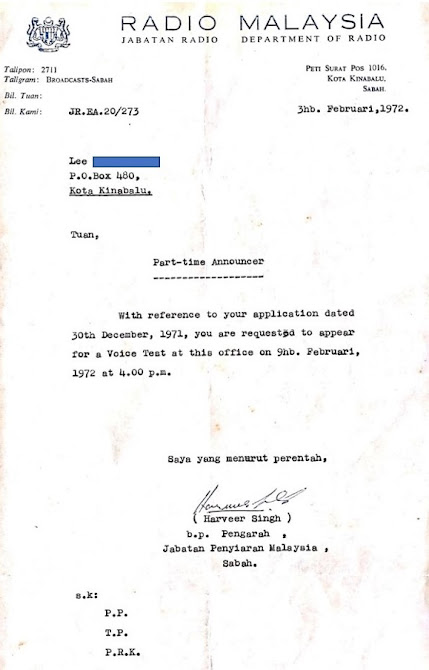
One of the jobs I considered particularly "prestigious" was my part-time role as a Hakka-newsreader for Radio Television Malaysia (RTM) between 1972 and early 1973. Before I was accepted, I had to pass an audition to assess my voice quality, which was personally evaluated by the producer. 

Unlike today's pre-recorded segments, news had to be delivered live, which was incredibly stressful at first. I would rehearse the script several times to ensure I was familiar with every word before going on air at the scheduled time. The original news was translated from English into Mandarin, and I was tasked with reading the same script in Hakka. This proved challenging, as certain phrases did not translate smoothly, and some words didn't sound right in Hakka. Often, I had to quickly think of the most accurate and natural-sounding Hakka equivalents in the brief time I had before going live. 

For each 10-minute session, I was paid RM7.50 - a modest sum, but the experience and sense of pride were far more valuable.
Letter from Radio Malaysia asking for a voice test.
A payment voucher for payment of RM22.50
for three sessions done in March 1972.
******************************
When I took on the job as a part time newsreader, I was working full-time as a draftsman with the Public Work Department (PWD). The PWD office was located in the Jesselton town centre (now known as Kota Kinabalu), in a building that is currently occupied by Standard Chartered Bank. 

As soon as office ended at 4.15pm, I would rush to catch a bus along Tuaran Road to reach RTM station, which is now situated next to Komplek Karamunsing. If I was lucky, I'd arrive by 5.00pm, leaving me just half an hour to familiarize myself with the news script before going live at exactly 5.30pm. 

On one occasion, I didn't make it on time. The news slot was replaced with light music instead. The following day, I received a phone call from the producer, who was clearly upset and didn't hold back in expressing his disappointment. I was required to submit a written report explaining my absence. At the time, failing to deliver a scheduled news broadcast was no small matter - dead air was considered a serious breach.

Each broadcast began with the announcement: "This is Radio Malaysia Sabah, this is news time by Lee Teck Kiong....". Although my stint as a part-time newsreader was brief, many in local Hakka community still remember the name, having heard me read the news back then. In those days, many Chinese listeners appreciated hearing the news delivered in their mother tongue.
Technical Pens & Lettering Guides.
 
My time as a draftsman was also relatively short. I worked in the Structural Section at the PWD Headquarters, and although brief, the experience proved valuable - particularly during my third-year university design project, which required the structural design of a building followed by detailed drafting work. 

Unlike the more "glamorous" role of a newsreader, the early days of my drafting work were far from exciting. As a trainee draftsman, I spent the entire first week honing my handwriting - painstakingly practicing alphabets, numbers, and words over countless pages using a technical pen. After that, I was tasked with tracing words and sentences using the Rotring Lettering Guides. Only when my supervisor was finally satisfied with the consistency and neatness of my handwriting was I entrusted with the actual task of amending old drawings. 

My drafting career came to an end in April 1973 when I left Kota Kinabalu to pursue a degree in Civil Engineering at the University Malaya.

Today, good handwriting is no longer a prerequisite for draftsmen. With all drafting done digitally, trying to market yourself based on beautiful lettering would likely earn you the label of a "has been". As for technical pens and lettering guides - they've become nothing more than relics fit for a museum.

Sunday, February 23, 2014

Chapter 23: Celebrating Chinese New Year in the 1950s and Early 1960s

During a recent Chinese New Year celebration, it was heartening to see both immediate and extended family members coming together to help with preparations for the reunion dinner. The spirit of togetherness and shared tradition made the occasion even more meaningful.

Getting the barbeque sets ready.Shopping for food ingredients.

These days, the main focus of Chinese New Year is often simply to gather for a family reunion dinner. If time allows, some families may plan short trips or outings together.

But back in the 1950s and early 1960s, celebrating Chinese New Year was a much more elaborate and serious affair. Planning and preparations began several days - or even weeks - before the actual New Year.

At the top of the to-do list, my mother would travel to the shops in town (there was no supermarket back then) to buy a new set of clothes and a pair of shoes for each family member. A haircut was essential. In our family, my father would cut all the children's hair at home to save money, while he himself would go to a barber shop. My mother would visit a ladies' saloon to have her hair styled.
 
To prepare for the reunion dinner on the New Year's Eve, my parents would purchase all the necessary ingredients for the many dishes to be served. The shopping list also included festive treats, and snacks for us children and for visitors. My mother would buy tins of biscuits, packages of Chinese sausages, waxed ducks, and other goodies - not just for our own use, but to be wrapped and given as gifts to our neighbours.
 
Once the gift packages were ready, the older children were tasked with delivering them house to house. In return, neighbours would offer us similar gifts - often with nearly identical contents. I once asked my mother why we exchanged such gifts when, in the end, it seemed like every household ended up with roughly the same items. Her response was always simple, "It's our traditional practice". 

Only in recent years have I come to appreciate the wisdom behind her work. What may have seemed like a repetitive or "illogical" tradition was, in fact, a meaningful ritual that strengthened the bonds of friendship and mutual respect among neighbors - something that was deeply felt in those days, but is sadly much rarer now.
Chinese sausages & waxed ducks.
Nian Kau
Nian Kau was usually one of the must-have items in our festive gift package. It was a treat we enjoyed only once a year, as buying enough pieces for everyone would have been beyond our family's budget. So my mother would make them herself. 
The process began with soaking glutinous rice grains. Once ready, we'd take the soaked grains to my grand-uncle's house, just a short distance away, where they had a stone rice grinder to grind the rice grains installed in one of their two kitchens. This hand-powered flour mill was essential for turning the soaked grains into rice flour. 
The grinding required continuous effort. My mother would rotate the heavy stone grinder, while I had the important task of feeding the grains into the small opening at the top. It was a bit of a tricky operation. I had to squat beside the grinder, quickly stand up to drop a spoonful of soaked rice into the hole, and ducked back down before the rotating arm swung around and hit me. Timing was everything.
We came across a similar stone grinder in a small museum on Jonker Street in Malacca during our visit in 2012.
 
Large leaves of tarap tree.
Next came the house cleaning. Spider webs had to be cleared, and curtains along with mosquito netting were washed. To remove the webs from every corner of the house, we used a long pole with a bundle of twigs tied to one end. Curtains and mosquito nets were taken down and placed in an empty biscuit tin filled with water and washing powder. The tin was then heated to a boil to thoroughly clean the fabric, which was later washed, rinsed, and hung out to dry. 

The timber floor received a thorough scrubbing - sometimes with brushes, but most often using leaves plucked from tarap tree. These leaves, which cost nothing and grew abundantly behind our house, were large and covered with fine, hairy spikes, making them ideal for scrubbing, like natural sandpaper.
 
One afternoon after school, the older children would be tasked with clearing the walking trail that led from our house in the valley up to Harrington Road (now known as Jalan Istana). Any overgrown vegetation or tall grass encroaching onto the path was cut back to ensure it looked tidy. Slippery or uneven slopes were levelled, and steps were carved where necessary - this was done in anticipation of visiting relatives during Chinese New Year.
 
Every year, on the day before the New Year's Eve, the town's wet and fish markets would open from 4pm and stayed bustling until the following morning. The roads surrounding the markets were closed to vehicles, and every inch of space - from pavements to roadside corners - was filled with temporary stalls selling food ingredients and festive merchandise. My mother would usually head to this night market in the early evening to buy what she needed for the reunion dishes. Some of us children would tag along, serving as little coolies to help carry the heavy shopping bags.

Pre-Chinese New Year's Eve Night Market in Kota Kinabalu.
***************************************************
Pomelo
Once a year, in Chinese New Year's Eve, we would take a special bath using water boiled with Pomelo leaves. We never had trouble finding these leaves, as several Pomelo trees grew around our house. The traditional cleansing ritual was believed to wash away all the bad luck and negative energy accumulated over the past year.
****************************************************
On Chinese New Year's Eve, my father would set aside his work and step into the role of family chef. His specialty was Hakka Kel Nyuk - a rich, flavorful dish of stewed pork belly with yam - which we looked forward to all year, as it was only prepared for this special occasion.
*****************************************************
The first day of the Chinese New Year began early - at 5.30am, the children would be up on the balcony, eagerly lighting firecrackers. As soon as the first explosion rang out, it triggered a chain reaction throughout the village. One by one, neighboring houses joined in, setting off their own firecrackers in a continuous burst of sound that echoed for at least half an hour.

Breakfast that morning was simple but festive, usually consisting of Nian Kau, mandarin oranges and a variety of traditional goodies. Shortly after, my mother would gather the children to distribute angpau. Back then, the decorative red envelopes we see today - often provided by banks - didn't exist. Instead, angpau consisted of money wrapped in plain red paper.
 
The first day of the year was considered sacred. On New Year's Eve, our parents would sternly reminded us not to say anything improper or inauspicious. Words like "dead", "bad" or anything associated with misfortune were strictly forbidden - even words that sounded similar should be avoided. If a housefly or cockroach appeared on the dining table, it was spared - no killing was allowed on this day. Sweeping the floor was also prohibited to avoid "sweeping away" good luck, wealth, and prosperity. That day might well have been the only time of the year when no foul language was heard in any Chinese household.
 
Our Church held a special worship service on the morning of the first day - a tradition that continues even today. For the occasion, we all wore our best outfits: brand-new clothes and new shoes that had been prepared for the new year.
 
After the service, my father would often take us to the funfair or to watch a movie. At the time, many Chinese schools took advantage of the festive season to organize funfairs, both to raise funds for the school projects and to offer a joyful outing for the community.
 
During the rest of the holidays, village children would gather to light more firecrackers and play their favourite games. It was a time of simple pleasures and shared joy.
 
But like all good things, the celebration eventually came to an end. The new year holidays concluded quickly, and school resumed on the third day of the Chinese New Year. Much to our dismay, we had to drag ourselves back to class, struggling to shake off the festive hangover and return to the routine and pressures of school life.