Tuesday, March 19, 2024

Excursions in Shangri-La Rasa Ria

In our recent 3D2N stay at Shangri-La Rasa Ria Hotel, Sam signed up for two of the hotel's outdoor activities - "Night Walk" on Day 1 and the "Nature's Little Buzzers" on Day 2.

Night Walk which was guided by the Resident Naturalist promised us an encounter with rare species like bearcat, mouse dear, civet cat, slow loris, stick insect, reptiles and so on. In the end, after one and half hour walk, we did not see these rare species. We were led to see only species we are familiar with - some partially hidden scorpions illuminated by hand-held UV flashlight, a sleeping hornbill perched high up on a tree branch and a few green pit vipers.

From the lone hornbill sleeping on its own, I learnt a unique love story about Hornbill from the Naturalist which I did not know before. 
**************************************************

Once a female Hornbill responds to a male Hornbill's call, the pair forms a thick bond for life - love until death. Hornbills are fiercely protective of their families. Hornbills look for very high treetops or the highest tree on a high terrain to build their nest with plant pieces, mud and their saliva. The saliva helps in plastering and fortifies the wall. 

The female gets inside before the nest is completely sealed. The pair are now separated except by a small opening on one side of the wall. The male brings food for the female and feeds her through the small opening. This feeding process lasts for four months and during this time, the female would lay eggs, incubate them and then raise the chicks. At this time, the female also sheds her old feathers. At this period, the male chooses to sleep far away from the nest to avoid predators from knowing the nest location.

The feeding continues until the nest is too small to accommodate the mother and the chicks. The mother bird then breaks open the nest and from then on, the parent pair continues feeding the chicks until the chicks are big enough to survive on their own.

If by any chance, the male is hunted, killed or has dies, the female and her chicks would just stay put and eventually die inside the nest. To the female, the world is dead without the male. She chooses to die inside the nest the pair has built together. This is truly a tragic case of death through starvation and the agony of loss of love!
**************************************************
Briefing by the Resident Naturalist just
before the Night Walk.
Nice sunset just before the
commencement of the excursion.
Green pit viper.
This is where we saw a lone Hornbill asleep and perched near the tip of a tree branch. According to the Resident Naturalist, the Hornbill deliberately chooses this area with a purpose. In the event of an approaching predatory creature either from the main tree trunk or from the air, the vibration caused to the thin branch will instantly wake him up and he will fly away.
We were surprised to see a traditional hut built with bamboo that houses the Kulintangan. Olivia and Maddie had their first experience playing this traditional instrument!
**************************************************
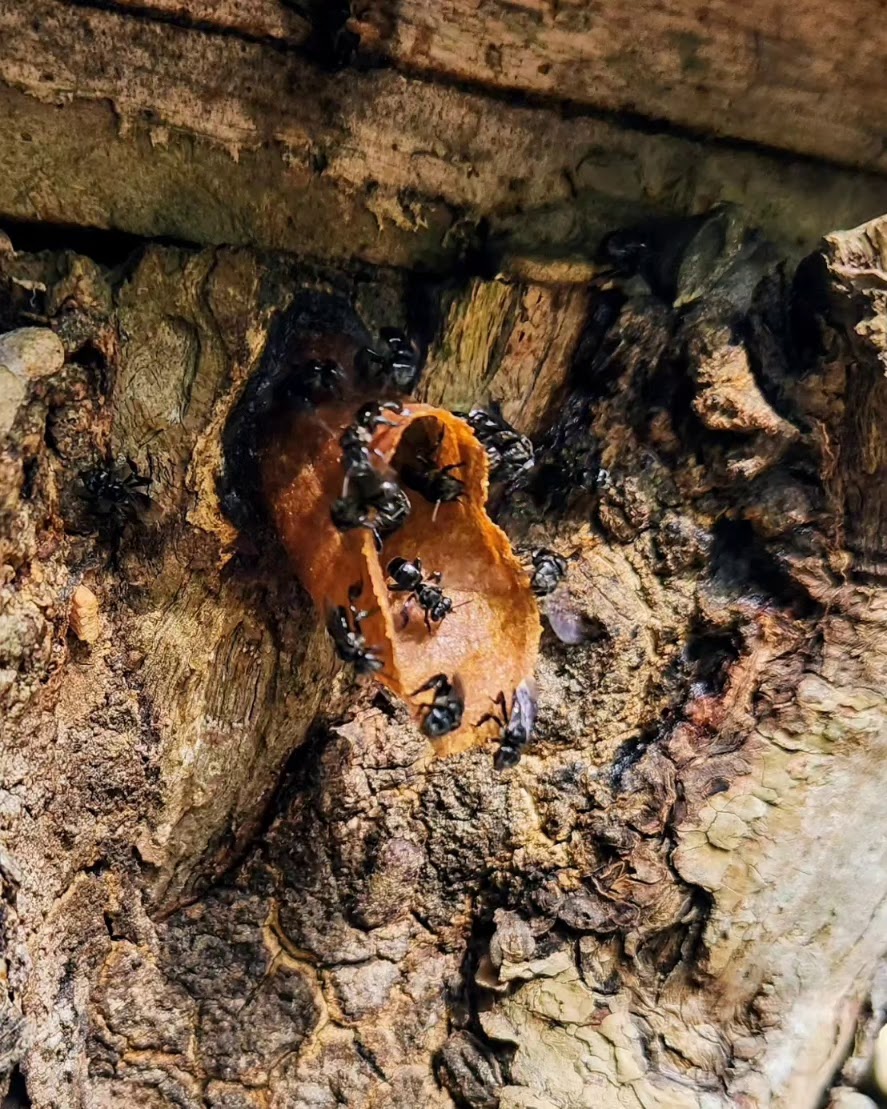
The Nature's Little Buzzers on Day 2 proved to be both interesting and educational. This tour focused entirely on the stingless bees commonly known as Kelulut in Malaysia.

I recall having seen these tiny bees typically 4 to 7mm length (more like little house flies) in my old village house, my old school buildings and even my mango tree at the back of my current house. I have seen them in hollow tree trunks and crevices in house wall.

At the end of the briefing, we were led to a shaded area placed with a number of Kelulut bee houses. Each visitor was given a chance to taste the raw honey either fed with a syringe or to suck directly from the honeypot using a straw.

We were told that stingless bee honey is less sweet, a bit sour and even slightly bitter. Stingless bees store their honey in honeypots which are made of cerumen, produced from bee's saliva and mixed with pollen, plant resins and flowers. All these have an effect on the taste. But the raw honey I tasted was mildly sweetish and hardly sour or bitter!
Typical Bee House.
Stingless bee honey is said to have medicinal and therapeutic benefits. Many kampong people are now involved in stingless beekeeping and sale of the harvested honey.

We are now very tempted to buy one or two of these bee houses and place them under our mango tree. Hopefully, this initiative will become a reality and one of these days, our grandchildren can suck raw honey at our backyard! :)

Monday, March 18, 2024

Favorite Moments of the Short Holidays in KK

Ever since the last visit to Sabah in July 2022, my granddaughter, Olivia has been pestering her parents to visit KK again.

The family finally came for a short holidays from 08.03.2024 to 14.03.2024. Some of the happiest moments of Olivia and her sister Maddie are - playing Lego toys, drawing and sketching, snacking, and watching their favorite TV series. 

Since our last family reunion in Perth in September 2023 less than six months ago, we noticed significant change in Maddie. She has become very sociable and approachable. This time, she has no hesitation to share moments with her Sabah grandpa and grandma whenever asked to.
Playing Lego toys, accumulated over the years since the childhood days of their parents in the 1980's is still one of the favourite activities.
First afternoon tea break after landing at
KK International Airport.
Mesmerized by "Peppa Pig" TV series.
**************************************************
Moments with gung-gung.
**************************************************
Maddie is enjoying a kiddle ride
at City Mall Shopping Complex.
At gung-gung's office on 09.03.2024.

Sunday, March 17, 2024

Exploring Sabah Food

Quite unlike Peninsular Malaysia and Sarawak, Sabah is unique in having numerous food named after towns and localities. We have Tuaran Mee, Tamparuli Mee, Beaufort Mee, Sinsuran Sang Nyuk Mian, Sandakan Dan Qiong Mian (山打根彈穹面) etc.

Whenever the families of my children are back to KK for holidays, chances are that they would look for some of these local foods. 

In the recent short holidays, we spent two days at Shangri-La Raya Ria Hotel. Since the hotel is near Tuaran, my DIL suggested to have Tuaran Mee for lunch at the second day. We decided to have Tuaran Mee at the outlet called Tuaran Mee Restoran in the new shoplots in Tuaran Town instead of at Restoran Lok Kyun. It turned out to be a disappointment. We should have gone to Restoran Lok Kyun at an old wooden shoplot which is the "inventor" of Tuaran Mee. In going through my old blogs, I was quite surprised to know that Jun Shi in her first visit to Sabah tasted Tuaran Mee at Lok Kyun while on the way to the Kinabalu National Park. Mind you, that was fifteen years ago in January 2009! (Read here).

Tuaran Mee Restoran and Restoran Lok Kyun
**************************************************
Sometimes, it takes outsiders to introduce new food outlets to us locals. Rachel introduced us to Tokmi Station in Sadong Jaya to savour their Roti Canai for a change. We traditionally go to Restoran Salim for Roti Canai and Roti Tisu (Read here).

*************************************************
Sam introduced us to "Hello Pizza Sourdough Co" at Curve 25 in Bukit Bantayan Residences. I was surprised that this Condo has food outlets besides residences. This condo is familiar to us as my wife and I has cycled passed this condo along Jalan Bantayan Minintod numerous times before (Read here). Curve 25 which was opened in June 2023 has outlets like Restoran Salim, Kedai Kopi Fook Yuen, Wen Coffee Cafe and Supermarket among others.
Pizza of Hello Pizza Sourdough Co.
************************************************
The night before we checked out from the hotel on 10.03.2024, we had seafood for dinner at a seaside restaurant we had been before - Our Land Eco Farm Seafood Restaurant (Click here). This restaurant is a mere 6.5 Km away from the hotel. One other attraction at this restaurant is the sunset view customers can enjoy.
**************************************************
Though the holidays was short, we did manage to have dinner at local Chinese Restaurants twice - once in Fu Ding Xuan in Inanam and then at Hee Yan Restaurant in Taman Sri Kapayan.
That dinner was our very first time at Fu Ding Xuan.
Dinner at Hee Yan joined by my brother, my SIL and 
my sister, the night before my son's family left for 
home the next day.
**************************************************
Breakfast at home.
Afternoon tea break at home.

Saturday, March 16, 2024

A Glimpse into the Family Roots

My daughter-in-law, Rachel was intrigued by a booklet on my maternal family tree, thoughtfully compiled years ago by one of my Muslim uncles (Read here). Over time, my extended family has evolved into a richly diverse lineage - both multi-racial and multi-religious - through intermarriages with people of different ethnic backgrounds. Among those of the Christian faith, our relatives now include Roman Catholics, Anglicans, Seventh-day Adventists, and BCCM/Lutherans, reflecting a tapestry of faiths that mirrors the changing fabric of Malaysia itself.

Earlier, I had promised my granddaughter Livvie that I would take her to see the old track I once used to reach my childhood home - a humble house built in a quiet valley next to Jalan Istana (Read here) and (Read here).

On 11 March 2024, that promise was fulfilled. I cannot be sure what Livvie felt as she stood on the steep trail for the first time, but for me, the moment was deeply moving. It felt almost surreal that, nearly three-quarters of a century after my grandfather and his son built that house in the late 1940s, members of our family’s third, fourth, and fifth generations could stand together once again on the very ground where my own life began.
****************************************************
We continued our journey and visited my old school premise situated at the end of Jalan Pinggir. This is the third visit since the CNY of this year. My son Paul and his wife visited on 8 February 2024 (Read here) and followed by the second visit with my former classmates on 18 February 2024 (Read here).
***************************************************
Coincidentally, during one of the evening excursions organized for guests at Shangri-La Rasa Ria, we were taken on a guided walk through the surrounding forest to spot birds, snakes, and small animals. Along the trail, our guide stopped at a traditional bamboo hut - a simple structure that instantly brought back memories for me. It closely resembled the bamboo house where my grandmother and her family once lived in Kampong Pulutan, back in the mid to late 1900s (Read here).

This humble hut within the hotel grounds serves as a small cultural exhibit, showcasing the Kulintangan, a traditional musical instrument of the Kadazandusun and Bajau communities. The Kulintangan is an idiophone ensemble consisting of six to nine small brass kettle gongs, each producing a distinct pitch. These gongs are carefully arranged on a low wooden frame, resting on rattan strings that allow them to resonate beautifully when struck. Once an essential feature of community celebrations and rituals, the Kulintangan continues to symbolize the rhythm and harmony of Sabah’s indigenous heritage.
***********************************************
During this short holiday, my daughter-in-law was especially eager to taste tarap - a fruit native to Borneo and beloved by locals for its fragrant aroma and creamy sweetness. Back in my childhood days, tarap trees grew abundantly around our village home. In fact, our old family radio’s long wire antenna was strung between two tarap trees - quite literally connecting us to the world through the very trees next to our house. You could say that tarap was deeply woven into the fabric of our village life.
Typical wire antenna tied to treetops and typical old radio.

There were also several tarap trees at my grandmother’s house in Kampong Pulutan, alongside many other fruit trees she planted. Sadly, our efforts to find tarap during this trip were in vain - it simply wasn’t the fruiting season.

As for my granddaughter, Livvie, she had no memory of ever eating tarap, even when I showed her photos of herself enjoying the fruit during her trip to Kota Kinabalu in September 2019 (Read here). That was understandable, of course - she was only two and a half years old then!
Tarap Tree (Photo taken in a fruits farm in Beaufort).
Photos of tarap tree and fruit downloaded from Internet.