Wednesday, April 10, 2019

Campbell Town, Tasmania

It was our initial plan to visit an old church for a Sunday worship service on our way from Bicheno to Burnie on 31 March which happened to be a Sunday.

Our internet search led us to "The Church", a restaurant converted from a magnificent old sandstone church built in 1857. Before the drive, we had decided to stop at Campbell to have lunch at "The Church" before moving on to our next destination.

It was a surprise to see such a magnificent church building in such remote interior of Tasmania. Its Gothic architecture and towering needle spire is comparable to those seen in some of the Eastern European countries. This Church building was once St. Andrew Presbyterian Church.
"The Church"
We did find "The Church", but the idea of having lunch there had to be abandoned as it has closed for business and the property has been put up for sale. 
*************************************************
The large number of old church buildings scattered in such a small town speaks of a once thriving Christian community in Campbell. Now with a population of under 800, it is no wonder that church buildings were closed and sold over the years since there are just too few church goers to sustain the continuation and maintenance of these structures and facilities. Campbell has become a transit point for short break and rest along the Midland Highway. Travelers stop here for toilet breaks, enjoy a walk in the park, have a meal in one of the food outlets and then move on.
Brickhill Memorial Church, built in 1879 and closed as a
church in 1964. Now converted to become a residence.
St. Michael's Catholic Church built in 1857.
*************************************************
In Campbell town, we took some time off to see the old Red Bridge built using convict labour in 1838. It consists of stone/brick abutments and timber top which had since been replaced. This bridge is the oldest surviving brick arched bridge in Australia. 
The Red Bridge spans across the scenic Elizabeth River.

Blowhole in Bicheno

Before visiting Bicheno, the only blowhole I have visited is in Albany (Read here). It was by accident that we discovered the Bicheno blowhole after noticing a road sign while driving in Bicheno small town.

The bursts of water coming out of the blowhole is dependent of the ferocity of the waves. Gush could go as high as 20 m. Capturing its most spectacular moments require focus and patience.
A group of non Australian young adults holding working visa helped us to capture a photo of us with the erupting burst as the backdrop. In return, we did a group photo for them, of course with a spectacular gush as a backdrop!

Driving Tour Surprises in Tasmania

One of the good things about self driving tour is that you can choose to stop at any time and any spot whenever you find something interesting. It can be a scenic spot, a historical site or a food outlet which offers something unusual. We had these experiences almost in all the places along our driving tours.

On our way from Hobart to Port Arthur on 29 March, we made a detour to the Tasman Bay National Park Lookout Point after sighting the signboard. Together with a sizable number of passing tourists, we had a good view of the bay and the southeast coastline of Tasmania.
*************************************************
The next day, we left Hobart for Bicheno. Along the way, we spotted this breathtaking coastline called Spiky Beach. Beside one other car which stopped nearby, we had the beach all for ourselves. We spent some time roaming around and enjoying the fabulous views and ambience.
*************************************************
After leaving Spiky Beach and driving along the Tasman Highway, about 25 Km before reaching Bicheno, we spotted a sign for Devil’s Corner. Without hesitation, we signaled right and turned into the public car park. There, we were welcomed by a tall, enclosed viewing tower erected by the winery. From the top of the tower, we caught sweeping views of Coles Bay and Tasmania’s Great Oyster Bay, and were mesmerised by the gently undulating terrain of the surrounding vineyards.

True to its name, Great Oyster Bay is renowned as a place to savour some of Tasmania’s finest seafood - oysters, mussels, scallops, lobsters and abalone.

Unfortunately, time was not on our side. We had to move on, missing out on many of the experiences and surprises the winery undoubtedly had to offer.

On any journey, one can never see, taste, or savour everything a place has to offer in a single visit. Perhaps that is why some destinations draw people back again and again, even to the very same places they have visited before.

  
*************************************************
In Bicheno, we would not have expected to encounter the blowhole or the penguins had we not been alerted by the signboards we noticed while driving around (Read here).

If there is one thing I will always remember about Bicheno - besides the penguins and the blowhole - it is its uniquely rugged, rocky seafront.

Massive rock formation protects the seafront of
Bicheno.

A Past Preferred to be Forgotten? - Port Arthur Historical Site, Tasmania

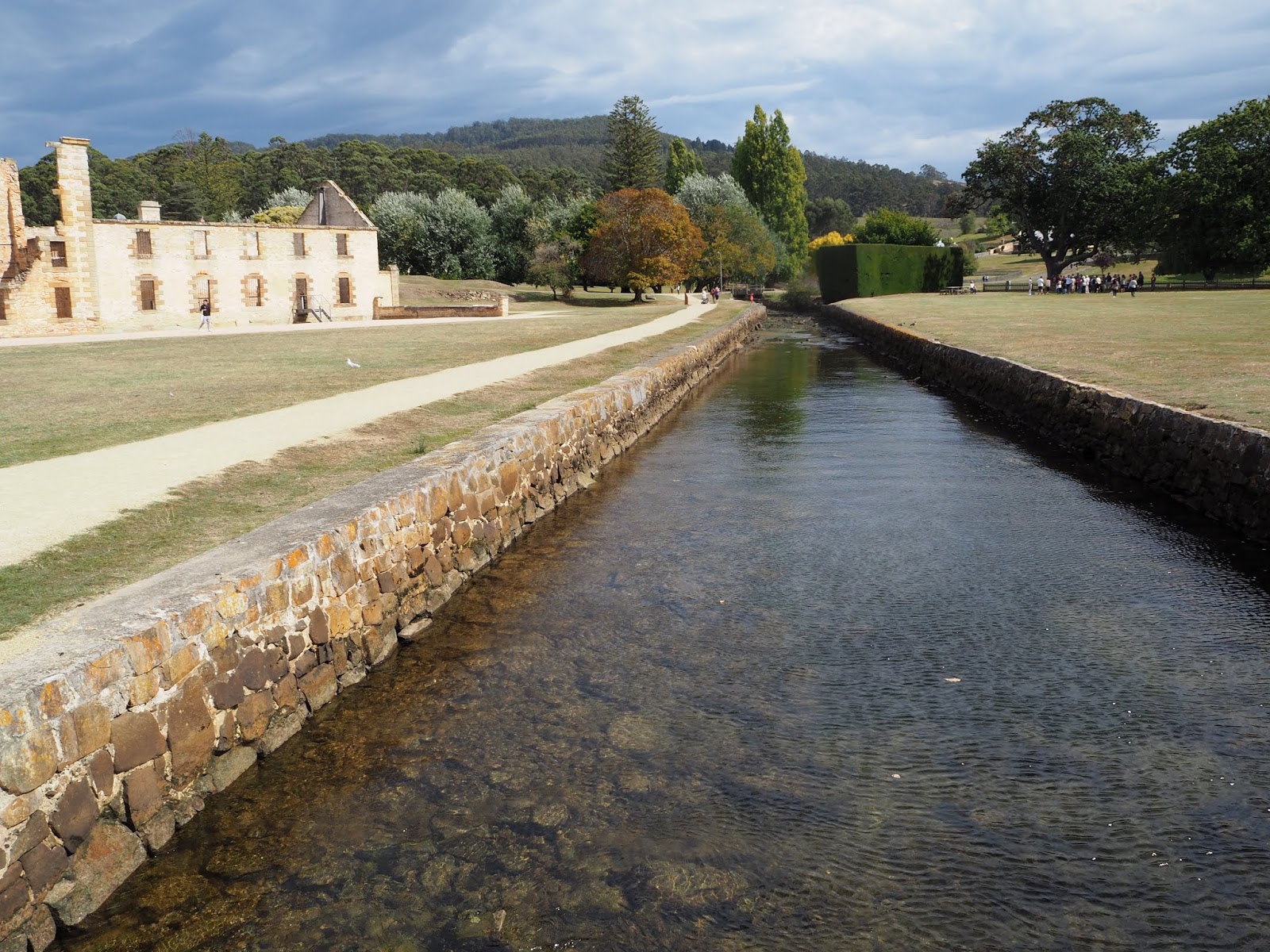
Quite many people hold the view that Australia was "founded" by the labour of convicts. When the British colonial power "discovered" the abundant timber resources and the potential of Port Arthur to be developed as a port, the idea of mobilizing penal labour was conceived.

Since then, according to the Guide of the Port Arthur Historic Site Introductory Tour, perception of many Australians about this part of history has changed. What was once conceived to be a noble idea of reforming criminals has since been perceived to be contradictory and even downright incompatible with current human right edict. There was feeling of shame and there were even voices of getting rid of this site and erasing it from the face of the earth. But the tourism money brought in by the arrival of visitors and convicts' relatives slowly neutralized such sentiment. Port Arthur Historic Site is now an open museum, a World Heritage Site - a piece of history that is here to stay and to last.

Port Arthur Prison was a brutal place. There are tales of recalcitrant prisoners being placed in isolation in standing position in pitch black chamber 24-hr a day for a month. It is not hard to imagine why some convicts "lost" their minds!

In the Isle of the Dead, this is where convicts, solders, prison guards, free men and free women were buried. Non-convicts were assigned at the upper level of the hill while convicts at the base of the hill. One obvious difference is that convicts were buried in unmarked graves. According to the Guide, the reason for the absence of tombstones was that criminals were deemed to be destined for hell and so identification was unnecessary.

I was glad that Junshi reminded us to spend a day at this Historic Site. At the end of the tour, I left the Site perplexed and in bewilderment. For a reform and rehabilitation institution presumably founded on biblical principle, I couldn't reconcile the rationale that convicts were pre-determined to go to hell when about 1,800 years earlier, a convict who was nailed with Jesus was declared fit to enter heaven to enjoy eternal glory!
The penitentiary, once housed hundreds of convicts in
dormitories and solitary cells
Once the hospital.
The restored Pastor's residence.
There are no seats at the prison chapel. All convicts were to stand for the whole duration of the service.
*************************************************
Habour Cruise.
We signed up for a habour cruise during the visit. The cruise passed through this islet that once housed the Point Puer Boys Prison. Around 3,000 children between the ages of nine and sixteen served sentences there.