Sunday, February 09, 2025

Food Galore in CNY 2025

For overseas returnees to celebrate CNY with their family, the occasion provides another opportunity for them to explore and taste their favourite food they have enjoyed in their original hometown. As in previous occasions, searching for and eating their favourite food is one of the key agenda. (Read here) and (Read here).
Breakfast on 23.01.25: Tuaran Mee at Tuaran Mee Restaurant, Inanam.
Dim Sum breakfast at New WK Restaurant on 26.01.25.
Dinner on 26.01.25 at Chennai Recipe Restaurant at
Borneo Suites Hotel.
Roti Tisu served at Chennai Recipe Restaurant.
***************************************************
Indian food breakfast again on 31.01.25 at Restaurant Salim at Bukit Bantayan.
**************************************************
Day 4 of CNY, we had lunch at Ah Yen Inanam in Inanam Capital. Traditional Fried Pork. When bowls of the "Traditional Fried Pork" were delivered to our table, Nathan exclaimed, "This is the dish I have been looking forward to. Unfortunately, I just couldn't recall its name!"
***************************************************
Before we explore Gaya Street Sunday Market on Day 4 of CNY (01.02.2025), we had breakfast at Restaurant Keng Wan Hing, an old food outlet well known for baked buns and steamed bao.
We ordered their dry-stir noodle (right) and beef meehon soup (left). These dishes are only so so and nothing exceptional!
*************************************************
Two days after Serene left for home, we were at Bornion Centre on 05.02.2025 and found Kedai Kopi Kai Shun finally opened for business after closing for the CNY holidays. We knew Nathan would have loved to eat their Minced Meat Noodle which some call it Sarawak Kolo Mee. Unfortunately, the outlet was closed during their stay in KK. 
Minced Meat Noodle at Kedai Kopi Kai Shun.

Saturday, February 08, 2025

Revisit Jesselton Artisan Market & Gaya Street Sunday Market

Unlike the Gaya Street Sunday Market, which features a mix of traditional street vendors and local produce, the Jesselton Artisan Market stands out for its curated selection of Sabahan-made products - from hand-dyed batik cloths, intricate beadwork, and charming souvenirs to contemporary art pieces and other handcrafted goods that reflect the creativity of local artisans.

We visited the Jesselton Artisan Market on Sunday, 26 January 2025, right after enjoying our dim sum breakfast at New WK Restaurant. The market, with its lively yet relaxed atmosphere, offered a refreshing contrast to the bustle of Gaya Street - a perfect place to stroll, browse and appreciate Sabah’s growing community of makers and artists.

In the end, we were certainly not disappointed - the ladies found exactly what they came for, leaving with smiles (and shopping bags) to show for it.
**************************************************
The following Sunday, 2 February 2025, we made our way to the Gaya Street Sunday Market. By then, Paul and Junshi had already returned to Singapore, leaving the rest of us to continue exploring Kota Kinabalu at a more leisurely pace.

Before joining the bustling crowd that morning, we stopped for breakfast at Restaurant Keng Wan Hing, a long-established local favourite renowned for its freshly baked buns and steamed bao. 

Gracie's having the Dry-Stir Noodle.
One lion troupe took advantage of the huge crowd, they stopped at every store to get angpow!

Friday, February 07, 2025

Learning About Cultural Diversity of Sabah

On the second day of CNY 2025, we visited Mari Mari Cultural Village at Kiansom. This Cultural Village established almost thirty years ago in 1996 is to showcase the diverse customs and traditions of the numerous tribes in Sabah.  

Compared to the Sarawak Cultural Village in Kuching where we spent a morning in November 2018 (Read here), Mari Mari Cultural Village offers a much more comprehensive guided tour that enhances visitors' visual, audio and taste experience.

At the Rungus house.
Inside a Bajau house.

Getting permission to enter the Murut village.
*************************************************
The plus point of Mari Mari Cultural Village is that visitors are given the chance to taste some of the traditional snacks of the indigenous people.
Kuih Panjaram - a traditional snacks of Bajau people.
Typical Kuih Panjaram.
Besides tasting Kuih Panjaram, one station also served the sweet and crispy snack called Kuih Jala. The process of making this snack is quite unique. The making requires a tin which is attached to a stick and it has tiny holes punctured at its bottom. Batter is then poured into the tin which then flows through the tiny holes into the hot-frying oil. Once the batter is fried, it is then quickly folded into the shape the cook prefers.
Typical Kuih Jala.
***************************************************
***************************************************
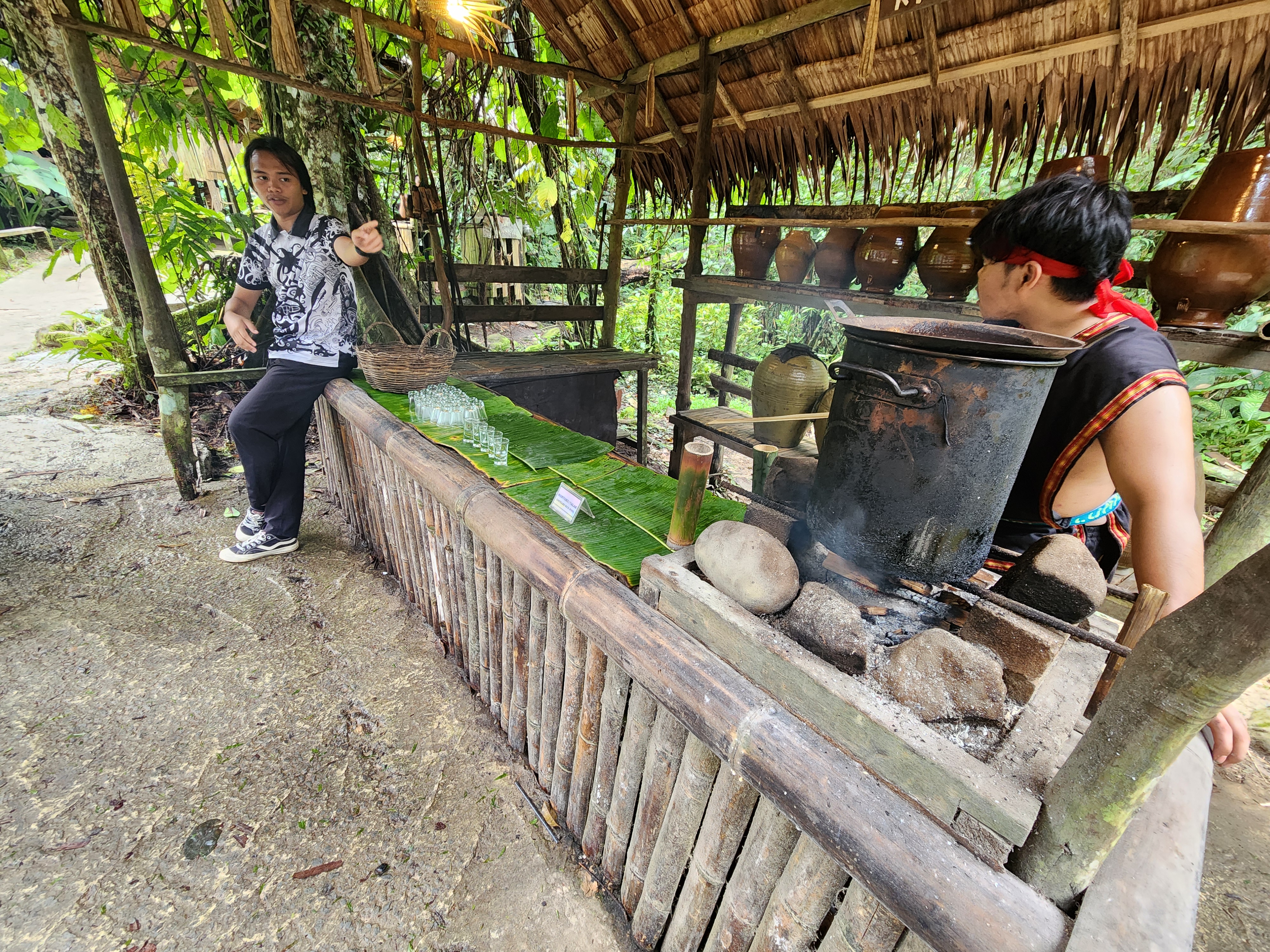
We were also shown the process of distilling traditional fermented rice wine or Tapai as the KadazanDusun call it. For the KadazanDusun, tapai is a significant culinary heritage and is served in festivals like Pesta Kaamatan, celebrations and cultural events. 

To some KadasanDusun, their love for drinking is part of their cultural identity - so much so that some even compare it as the Chinese's love for firecrackers during Chine New Year or the Muslim having ketupat during Hari Raya and the Indian displaying Rangoli during the Deepavali!
***************************************************
The Muruts are known to wear vest known as "babaru puputul" in the Murut language made from tree bark. The vest is made from the inner bark of the puputul tree which takes around 10 years to grow to the size needed before the bark can be harvested to make the vest.
At the station which showcased the making of Murut vest from tree bark.
***************************************************
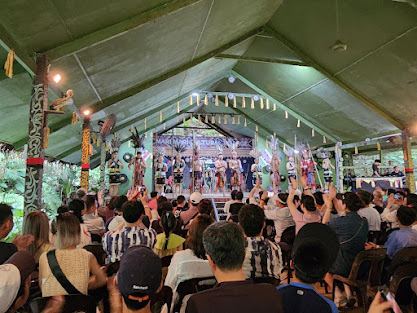
The finale of the event before adjourning to the buffet was a presentation of indigenous dances like Sumazau, Murut Magunatip Bamboo Dance etc.

Thursday, February 06, 2025

2025 CNY Eve Reunion Dinner

Having family reunion dinners together with family members of my siblings at major festivals have been a family tradition for as long as I can remember (Read here).

This CNY, this event which was held at my home was considered major because it was joined by families of Serene from Australia, Paul & Junshi from Singapore and families of Caleb and Calvin from KL. The last major gathering held at my home was in the CNY of 2019 (Read here). 

Preparing deep-fried nian gao for dessert.
The cousins though meeting for the first time, got on well in no time. Here they enjoyed playing the UNO card game.
**************************************************
Two tables were set up to accommodate the nineteen attendees.
Table for the older generations.
Table for the younger generations.
Common among overseas returnees to their home town for CNY, they look forward to eating CNY food which they had in their childhood days. Hakka pork belly with Taro, Hakka yong tau foo and the Chinese white cut chicken are among the favourite dishes! 

I still remember in the 1970s when I came back for vacation during my university days which coincided with CNY season, these dishes prepared by my parents which I grew up with evoke a sense of home, family and belonging. Eating these foods during CNY helps reconnect with my roots and relive cherished moments from my childhood.
****************************************************
Photo session after the meal.
Nathan, the big brother of his generation! With his sister Grace,
cousins Asher and Hannah - the two children of Caleb..
Playing firework after the meal!
This time, the younger generations truly enjoyed each other company. Families of Caleb and Calvin finally left close to 11.00pm!
****************************************************
My older brother last attended a family reunion dinner in CNY 2023. Since then, he could no longer participate due to health and mobility issue.

This year, Serene's family paid him a visit on 30.01.2025 during the second day of CNY 2025.