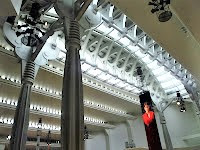
We managed to see the two tallest buildings in Taiwan. Tuntex 85 Sky Tower in Kaohsiung and Taipei 101.
TUNTEX 85 SKY TOWER, KAOHSIUNG



TAIPEI 101








When OKK Rampas Gumpai served as a court official, his wisdom, intelligence, and fair judgment earned the respect of both friends and adversaries. One memorable story, often recounted by his brother Dungko, illustrates his remarkable ability to resolve even the most complicated cases.
This particular case, involving a disputed ownership of a buffalo, had remained unresolved for four years, despite being handled by several OKKs across multiple districts. Finally, in 1958, it was referred to OKK Rampas. Upon reviewing the case, he calmly remarked:
“This is an easy case to resolve. I don’t need the formality of a courtroom, or tables and pens.”
When the day of the hearing arrived, a large crowd gathered, curious to witness how he would settle the long-standing dispute. The case involved two men - one Lotud and one Bajau - each claiming ownership of the same buffalo. OKK Rampas asked the buffalo to be placed in the middle of a large open field, and then instructed the two claimants to stand at opposite ends. He told both men to call out to the buffalo. The man to whom the buffalo responded would be declared the rightful owner.
As the two shouted and coaxed the animal from afar, the crowd watched in tense anticipation. After a moment of hesitation, the buffalo slowly made its way toward the Lotud man. With that, OKK Rampas announced the verdict. The field erupted in applause, and the crowd gave him a standing ovation.
The creativity and fairness of his approach not only resolved the case but elevated public admiration for his judicial wisdom to a new level. However, his rising prominence also stirred jealousy and unease among some of his peers and colleagues.
It is said that about a month after the case, OKK Rampas attended a celebration in Tuaran. The next day, he fell seriously ill, vomiting blood. Many believed he had been poisoned. He never fully recovered, and sadly, he passed away in 1966. Around this time, he also remarried his fourth wife, Limpoton.
This story raises some intriguing questions:
If the buffalo ownership dispute really dragged on for four years, what happened to the poor animal during that time? Where was it kept, and who was responsible for its care and well-being?
Could a buffalo truly recognize and respond to its rightful owner after such a long separation?
The tale also brings to mind the biblical story from 1 Kings 3:16 - 28, in which King Solomon resolved a dispute between two women claiming to be the mother of the same baby. Instead of a buffalo, the contested subject was an infant. The story concludes with this powerful line:
“When all Israel heard about the judicial decision which the king rendered, they respected the king, for they realized that he possessed supernatural wisdom to make judicial decisions.”
Whether it was due to Rampas’ wisdom or his other leadership qualities, both he and his brother Dungko were often sought after and courted by aspiring politicians. One such figure was Donald Stephens - later known as Mohammad Fuad Stephens after his conversion to Islam - who would go on to become the first Chief Minister of Sabah.

.jpg) |
| Colourized Photo. |
 |
| 1907 - 1966 |

During the Japanese occupation of North Borneo, life in the kampung became even more difficult. With access to supplies from the local tamu (market) cut off, villagers were forced into hard labour, including road construction, and compelled to surrender their farm produce to the Japanese forces stationed in Tuaran. The Japanese Kempetai appointed local inhabitants to act as their agents and representatives, instructing them to collect food and other necessities from the villagers. Disobedience was met with brutal consequences - those who failed to comply risked being shot or executed.
In 1945, Orang Tua (OT) Lingguman, the village head of Kg. Ranap, was executed by the Japanese under suspicion of collaborating with the Chinese resistance. Following his death, the Kempetai appointed Rampas as his replacement - both as their agent and as a clerk responsible for continuing the collection of produce from the area. Rampas carried out his duties diligently, earning the trust of the Japanese authorities.
During this period, movement was heavily restricted, and survival was harsh. Many villagers fled to remote areas to hide. Almost all Dusun labourers, who had been working in rubber estates owned by Chinese and European planters, abandoned their jobs and returned to their home villages for safety. Tragically, many conscripted workers tasked with building roads died from cholera, malnutrition, and the absence of medical care.
The defeat of the Japanese by the Allied forces in the Pacific brought peace and a renewed sense of hope to North Borneo. With the British assuming control from the harsh Japanese regime, the people looked forward to a more stable and just administration.
In 1947, Rampas was appointed as the Orang Tua (OT) of Kg. Kiulu by the Tuaran District Office. The following year, in 1948, he was promoted to Orang Kaya-Kaya (OKK) of the Kiulu area, a position he held until the late 1950s.
During his tenure, OKK Rampas demonstrated outstanding leadership and foresight. One of his most notable initiatives was the distribution and clearing of land for rubber plantations, aimed at boosting the local economy. He also encouraged rural villagers to move from remote, isolated areas to settlements closer to more developed urban centers, improving access to services and infrastructure.
At the time, the British colonial government had prohibited private individuals from planting rubber. Those who disobeyed faced punitive action. However, OKK Rampas showed both courage and defiance by personally instructing the villagers to proceed with rubber planting. To reassure those who were uncertain or fearful, he boldly told them:
“If anyone asks you who gave you permission to plant rubber, just say it’s from Rampas.”
Empowered by his words, many villagers began clearing the forest and planting rubber trees. Some also started ploughing and cultivating their land for other crops.
In distributing land, OKK Rampas was notably fair and inclusive. Land was allocated to anyone willing to work it - regardless of gender. Initially, each person received five acres, but this was later increased to fifteen. He appointed village heads to oversee the land distribution process and personally visited various kampungs to ensure the land was being properly utilized.
In 1951, OKK Rampas applied for a government grant to build a road linking Tamparuli to Kiulu. The application was approved, with the condition that construction would be carried out by local villagers. While the exact amount of funding remains unknown, he introduced a fair payment system: RM60 was paid for each chain of road built, RM80 for steeper terrain, and RM40 for flat sections. The road was completed by 1953, but due to its narrow and hazardous sections, it wasn’t until 1955 that the first vehicle - a Land Rover - successfully made the journey to Kiulu.
Recognizing the importance of education, OKK Rampas spearheaded the construction of a school to serve the children of Kiulu. In 1952, Sekolah Rendah Kebangsaan (SRK) Pekan Kiulu was established. Due to the region’s difficult terrain and lack of roads, construction materials such as cement and nails had to be airlifted by helicopter. Roofing zinc sheets were transported via rafts along the Tuaran River, a treacherous journey made difficult by numerous rapids. Timber for the school and teacher quarters was sourced from nearby forests. OKK Rampas even taught locals how to plank timber boards from logs. The old shop houses in the town were constructed by local craftsmen using these locally sourced materials.
By 1950, OT Saguman was the only trader in Kiulu with a license to operate a shop, making him one of the earliest shopkeepers in the area. OKK Rampas also owned several shop houses, although he later sold three of them to other individuals. He played a pivotal role in bringing a Chinese trader to Kiulu - an individual who went on to become very successful, with his descendants continuing the family business and maintaining their legacy in Kiulu to this day.
 |
| SRK Pekan Kiulu built by Rampas in 1952 |
 |
| Old shop houses built by Rampas in 1953 |

