Saturday, February 10, 2024

Chapter 37: CNY Unicorn & Lion Dance of Yesteryears

On 2 February 2024, Pope Francis received a delegation from the Italy-China National Federation in a special audience at the Apostolic Palace in the Vatican. Among the highlights of the visit was a vibrant cultural performance by a troupe from the Chinese Martial Arts Academy of Vercelli, who brought the traditional Dragon and Lion dance to life within the Vatican walls.

In a symbolic and rarely seen gesture, Pope Francis was invited to perform the "dotting of the eye" on the Lion - a ritual deeply rooted in Chinese tradition, believed to awaken and empower the Lion to fulfill its role of bringing good fortune, health, and prosperity to all present. This act, often carried out at the beginning of festive celebrations, was met with appreciation by many as a gesture of goodwill, openness, and intercultural respect.

Yet, the moment was also striking in its rarity. It is uncommon to see the head of the Roman Catholic Church engaging in a practice that some conservative followers might perceive as incongruous with their theological framework. Nonetheless, the Pope’s action reflects his broader vision of dialogue, cultural exchange, and a Church that reaches out beyond boundaries- both geographical and ideological.

**************************************************
In the 1950s through to the mid-1960s, the old Lok Yuk School at Signal Hill - where I completed my primary education and part of my secondary education - had its own unicorn dance troupe. What made it special was that the troupe members were students of the school themselves. Each year, in the lead-up to the Chinese New Year, they underwent intensive martial arts training in preparation for public performances around the town of Jesselton (now Kota Kinabalu).

Throughout the festive season, the troupe members made a notable sacrifice: they had to forgo celebrating Chinese New Year with their families, relatives, and friends. I believe it was a sacrifice they accepted willingly, with pride. One of my primary school classmates, who also happened to be my neighbour, was an enthusiastic member of the troupe. During that season, he was absent from our usual childhood routines - roaming the village, playing games, setting off firecrackers, and receiving ang pow from the elders.

Every year, before the unicorn was officially launched for the New Year festivities, a Blessing Ceremony was held. I remember taking part in one such ceremony, possibly in 1964 or 1965, when I was either in Bridge Class or Form One. The ceremony, traditionally conducted in the late afternoon or early evening of Chinese New Year’s Eve, was held at a small hill beside the old basketball court. It was led by the church pastor and attended by the troupe leader, the unicorn handler, and other participants. The ceremony began with a short exhortation followed by a prayer of blessing for both the unicorn and the troupe members. Then came a symbolic act: the unicorn was led to pluck a few green leaves from a nearby tree, chew them, and swallow. This gesture signified that the unicorn had been fed and was now ready to begin its duties.

The unicorn troupe of Lok Yuk School was eventually disbanded, likely sometime between the mid to late 1960s. The reasons for its dissolution were never made fully clear. However, I recall hearing murmurs from some members of the Basel Church that maintaining a unicorn troupe under the church's jurisdiction conflicted with the Christian faith. It was common during performances at homes where ancestral worship or Buddhist practices were observed for the unicorn to bow or pay homage at altars - acts some deemed inappropriate for Christian students to participate in. Whether this theological concern directly led to the troupe’s disbandment remains uncertain, but it may well have played a role.

Interestingly, around the same period, La Salle School in Kota Kinabalu - under the Roman Catholic mission - also had a lion dance troupe. That troupe, too, was eventually disbanded.

Colourised Photo.
A female schoolmate, Lynette recently pointed out that she and another classmate of her were also members of the troupe. She is seen squatting next to a unicorn at front row second from left in this old photo. Her classmate , a daughter of a Pastor of Basel Church Jesselton then is at her left.
Troupe performed along the streets of old KK.
***********************************************
These days, lion, unicorn, and dragon dance troupes remain a vibrant part of the cultural landscape in Kota Kinabalu. Many are now organized under the boards of Chinese vernacular schools or managed by Chinese temples. While the traditions continue, an interesting shift has taken place in recent years: the ethnic composition of these troupes has changed significantly.

In some cases, the majority of troupe members are no longer Chinese. For instance, in the SJK(C) Yick Nam Dragon, Unicorn, and Lion Dance Troupe, Chinese students reportedly make up only about 5% of the members. (Read here)

I wrote a blog post back in February 2013 reflecting on the state of lion dance and its connection to Chinese cultural identity. A decade on, the trend of declining Chinese participation in these traditional performing troupes not only persists - it appears to be irreversible. (Read here)

In contrast, an encouraging development has been taking place in Australia. In Perth, the lion dance is enjoying a surge in popularity, particularly among Australians of Chinese descent. This resurgence can be attributed to the active efforts of Chinese clan associations that promote cultural heritage and identity through lion dance. Additionally, many Chinese parents there encourage their children to take part in lion dance troupes, seeing it as a meaningful way to stay connected to their roots while learning valuable skills and discipline through the art.

This heartening news was shared with me just this morning during an online Bai Nian session with family members from Australia and Singapore - a timely reminder that while traditions may evolve or shift in one place, they can also flourish and find renewed life in another.

Thursday, January 25, 2024

Chapter 36: Master Tailor

25 January 2024 marks the 18th Anniversary of my father's passing. He left us in early 2006 (Read here), and had he been alive today, he would be 96 years old.

On 1 June 2022, my older brother shared a photograph that stirred many memories - a group shot from a grand reunion held in 1967 for alumni of the Boog Tsin Tailor Training College. My father was among them, a proud graduate of that institution.

At the peak of his tailoring career, my father was widely respected as a master tailor - a reputation that would become his enduring legacy. He worked at Chu Chu Tailor, one of the most well known tailoring shops in the old town of Kota Kinabalu. Yet his craft didn't end there. He was frequently approached by clients from all walks of life - teachers, students, pastors, working professionals - for customed-made clothing during his spare hours.

Spare hours, however, were almost non-existent. He worked tirelessly, nearly seven days a week, reserving only Sunday mornings for church. Each evening after dinner, he would sit down at his sewing machine and continue tailoring until 10pm. It was a rhythm of relentless discipline and devotion.

Despite the long hours he poured into tailoring, the drive just to earn a bit more for the family never left him. In the early mornings - often before sunrise - he and my mother would go rubber tapping to supplement the household income (Read here). It was a physically demanding job, but they took it on without compliant, motivated by their desire to give us a better life.

For his private tailoring work, my father accepted a wide range of orders - pants, long-sleeved shirts, student uniforms, tuxedo suits, and occasionally, ladies' dresses. Yet I believe the work he was most proud of was being commissioned to create nearly all the pulpit gowns worn by the pastors and reverends of the Basel Christian Church of Malaysia. That assignment wasn’t just a job—it was an honor.

Throughout his career, my father also mentored aspiring tailors. One of them was my eldest brother, who had to leave school after completing primary education due to illness. To help him find purpose and keep him engaged at home, my father began teaching him the art of tailoring. Once he gained confidence in the craft, he became my father’s assistant, helping fulfill many of the private orders.

In those early days - before buttonhole sewing machines were available - every button and buttonhole was sewn by hand. My mother handled this delicate final step before the garments were delivered to clients. It was a quiet but essential contribution to the family business.

My father wasn’t a smoker, a drinker, or a gambler. He lived simply and honorably, dedicating his entire life to being a good husband, a loving father, and a tireless provider. Like many traditional Chinese men of his generation, he wasn’t outwardly affectionate. But we never doubted his love. It was written in every stitch he sewed, every early morning he rose, and every quiet sacrifice he made for our family.

A photo from the grand reunion of Boog Tsin Tailoring Training College held in 1967. My dad is in the back row, standing second from the left.
**************************************************
In April 2022, my youngest brother shared photos of the Single-brand sewing machine that was once used by my father. After doing some research online, he discovered - based on the serial number - that the machine was manufactured in 1945. Originally, it operated with a foot pedal and belt mechanism. Later, a motor was added when Single transitioned to producing electrically powered machines, significantly reducing the manual effort required to operate it.

Remarkably, this nearly 80-year old machine is still in working condition and remains in the house my parents last lived. Today, it stands as a cherished vintage piece with both functional and sentimental value.

***************************************************

An old photo shared on Facebook captures Jesselton - now known as Kota Kinabalu - in the 1960s. The photo was taken from Jalan Harrington (now known as Jalan Istana), just a short distance from the existing Jalan Dewan/Jalan Padang. On the left side of the photo is a row of timber shoplots, one of which was once occupied by Chu Chu Tailor (楚楚洋服). Other notable outlets in the row of wooden shops were Tung Nam Book Store (东南书店) which was next to Chu Chu Tailor and another nearby shop called Monmin Glass and Aluminum (文明镜庄).

A railway track ran alongside the tarred road in front of the row of timber shophouses. The line stretched from the seaport all the way to Tenom in the interior. The small timber hut on the left was used by the guard to operate the boom gate, stopping traffic whenever a train crossed the road.
Another old photograph captures the side and rear views of the same row of timber shophouses that once stood at the heart of Kota Kinabalu. From the Chinese signboards, common in that era, the corner lot housed 华隆貿易公司 (Hualong Trading Company), operated by the family of my primary school classmate, Lee Thien Fook, whom I met again in 2015 (Read here). A dental clinic, 王鴻飛牙科 (Wong Hong Fei Dental Clinic), was also located along this row and was well known in those days.

This entire stretch was eventually cleared to make way for the construction of the Kota Kinabalu City Library and the Dewan Bandaraya Kota Kinabalu (DBKK) complex.

Most of the displaced businesses were later resettled in newly built shoplots nearby. Tung Nan Book Store relocated to a reinforced-concrete shophouse along Jalan Gaya, where it continued serving customers before finally closing its doors on 31.03.2017 after more than six decades in operation.

Chu Chu Tailor, which moved to Kampung Air, ceased operations even earlier, fading quietly from the town’s commercial landscape even before the Tung Nam Bookstore’s eventual closure.

Meanwhile, Monmin Glass & Aluminium, which relocated to a new shoplot in the adjacent row next to Chu Chu Tailor in Kampung Air, still remains in business today. Its flagship building is now located at the SEDCO Industrial Estate Kolombong, continuing a legacy that stretches back to the early post-war years.

The disappearance of bookstores and tailoring shops mirrors wider global shifts shaped by the internet, industrialisation and now AI. Clothing production has largely moved to mass manufacturing, while reading habits have steadily transitioned from printed pages to digital screens. Yet the trade of aluminium and glazing works for buildings remains very much in demand - evidenced by the continued presence of Monmin in the local industry.

Today, the tailoring shops that once flourished from the 1950s to the early 2000s have all but vanished. Even Chu Chu Tailor, later run by the founder’s son, closed many years ago. Its former premises in Kampung Air have since been converted into a 4D lottery outlet.

I still recall that during my primary and secondary school years, many of my classmates’ fathers were tailors. Now, I cannot name a single man in the profession. What was once a male-dominated trade has gradually shifted, with the craft today more commonly practised by women.

My father, who worked in the labour-intensive craft of tailoring, belonged to a generation of master tailors commonly found from the 1950s to the 2000s - a breed of craftsmen whose skills now form part of living history.

The former premises of Chu Chu Tailor in Kampung
Air are now occupied by a 4D lottery outlet.
Current flagship building of Monmin in Kolombong.

Sunday, January 21, 2024

Chapter 35: Cycling Back into Memory - Old Lok Yuk School Basketball Court

Our Saturday morning cycling routine often becomes a journey through memory as much as through the familiar routes. Each ride gives us the chance to rediscover familiar streets and occasionally stumble upon places we had long forgotten.

On 20.01.2024, after conquering the climbs of Signal Hill, Jalan Istana and Jalan Tuaran near Sunny Garden, we veered off toward Jalan Pencetakan Baru, a turn that eventually led us to Taman Fantasi. There, after a short uphill ride, we paused in front of the STS Students’ Hotel Block.

***************************************************
Standing at that spot stirred a rush of memories. This was once the concrete-lined basketball court of the old Lok Yuk School.

Perched atop a hill with scarcely any level ground, the school depended on this court as its central activity space. It hosted spirited basketball matches, physical education lessons, and even athletics activities such as running drills and relays. On cooler days, it became a favorite gathering spot during recess, where students lingered to chat and unwind.

In the 1960s, when the old Lok Yuk School had a unicorn dance troupe, a small hill beside the basketball court served as the site of the blessing ceremony held on Chinese New Year’s Eve before the troupe began its performances and duties (Read here).

I remember clearly that one side of the court was fringed with dense growth of nibong palms - tall, slender trees with single trunks covered in hard, sharp black spines. Whenever a stray ball landed among them, retrieving it often meant enduring a painful prick or two from those unforgiving spikes.
The greenery around the court formed such a picturesque backdrop that the school management frequently chose this spot for class photographs, capturing generations of students against a natural forest setting.

When Sabah Theological Seminary later took over the old Lok Yuk School premises, the basketball court inevitably gave way to the construction of the multi-storey students’ hotel block. What stands there now is a modern structure, but beneath it lies a space once filled with the energy, laughter, and memories of countless school days.
Old photo of the basketball court.
Colourized photo.
Below the basketball goal support frame was a favorite gathering
place during recess, where students lingered to chat and unwind.
Colourized photo.
In the late 1960s, lantern processions through the town of Jesselton (now Kota Kinabalu) were occasionally held in conjunction with Malaysia Day, .

For the Lok Yuk School contingent, students first assembled at the basketball court before walking down the hill track to join the main procession in town.
***************************************************
Bridge Class and teaching staff photos taken at the basketball court in 1964.
Colourized photo.
Class Photo of Bridge Class in 1964.
I am at 4th from right in the front  squatting row.
Form teacher is Mr. Chang from Hawaii sent
by Lutheran Church of America. 
Teaching staff and school principal
(Rev. Donald E Nelson, 1st at right in front row) of 1964.

Sunday, December 31, 2023

Lunch with Former Badminton Buddies

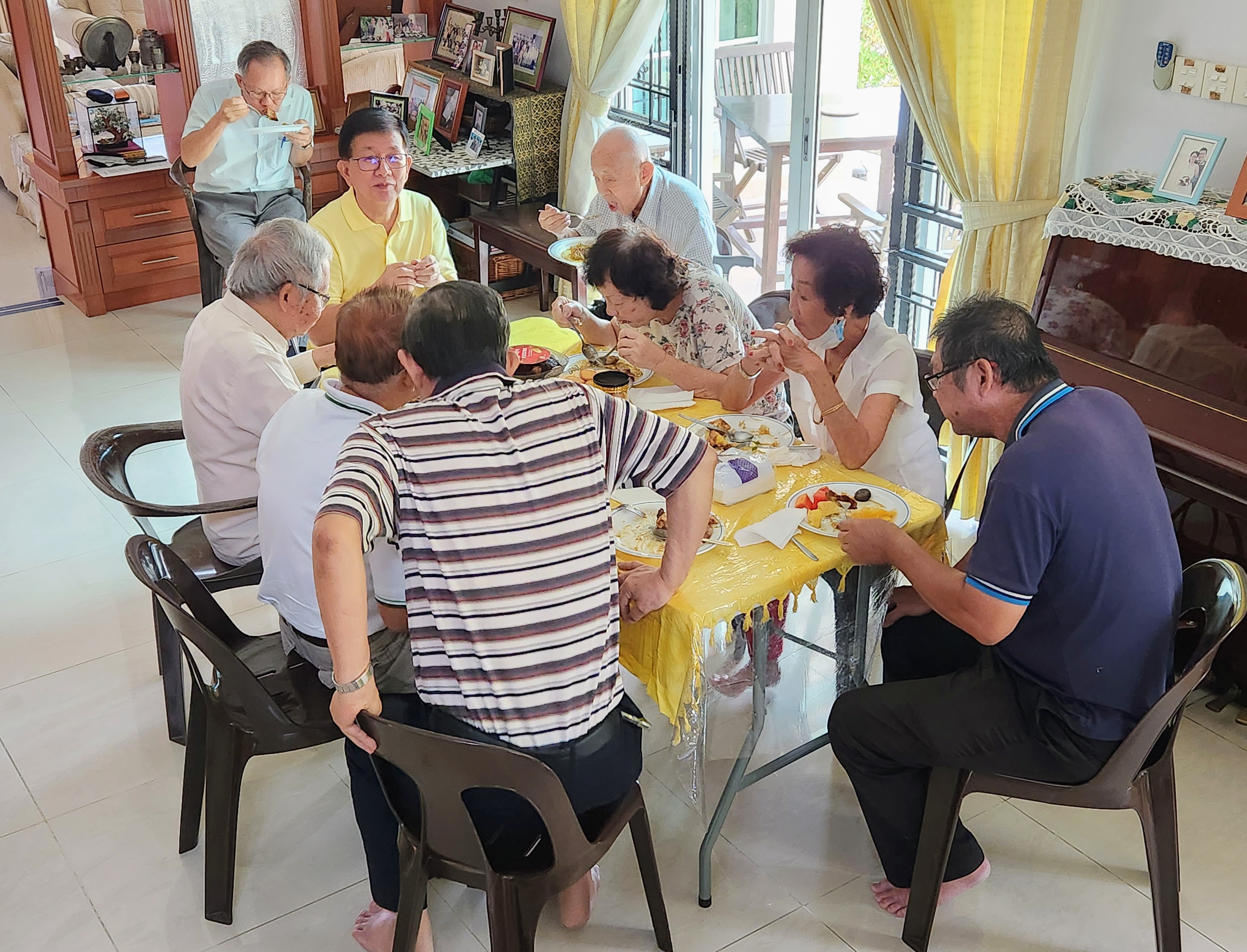
We had a reunion lunch on 28 December 2023, three days before the end of 2023. Attendees of this reunion are former badminton kaki or buddies who used to play badminton at Basel Hall at least twice a week for over thirty years from 1980's to 2000's. The group last met for a meal on 10 October 2022 when one of the ex-players came back from Vancouver, Canada (Read here).

Now, we call ourselves, "The Badminton Survivor Group" because we know the number will dwindle over the years. I have written earlier that some of the members had already passed on. First is Peter Lee on 4 March 2019 (Read here), then John Wan on 27 March 2022 (Read here) and Tai NK about a year and a half ago on 6 July 2022 (Read here).

***************************************************
2023 did not end in an entirely happy note.  There were heavy-hearted moments after reading the news of the suicide of a South Korean actor, Lee Sun Kyun. He died just a day before our lunch date. 
Sun Kyun, a recipient of "Excellent Achievement in Film" Award, was at the peak of his career when chose to end his life because he found no other way or incentive to continue living. As he put it in his suicide note, "I cannot do anything else, there is no other way but this". With his acting career practically in ruin and a looming contractual penalty of 10 billion won (RM$33 million), he chose death as a way to end the mess. My speculation is that he chose death to ensure that the well-being of the rest of his family is kept intact, at least financially! 

His tragic end is a case of getting involved with the wrong people and committing an improper act either knowingly or unknowingly that gave rise to blackmail! 

Monday, December 18, 2023

Impending End of Year 2023

This year, we decided to open our home for a Christmas Pot Bless Lunch Celebration for our CG on 15 December 2023. Quite remarkably, we had a similar event at our home four years ago in December 2019 (Read here). In my blog written soon after that event, I concluded with the hope that 2020 would be another great year!

2020 turned out to be a year way beyond the expectation of all people around the world. Almost immediately after our 2019 year-end Pot Bless gathering, Covid 19 virus struck. Country after country started lock down to contain the spread of this global pandemic.  Travels within country and cross border were suspended. Schools, colleges, universities and work places were closed. Church services and gatherings in religious premises were too all suspended. For the first time, we began working online, study online, meeting online, worship online..... Traditional ways of doing things gave way to new ways of doing things!

Once Covid was contained and when the pandemic was slowly being accepted as being endemic, physical meetings and gatherings resumed. Our CG switched the regular meetings from home gathering to meeting in the Church premise (Kyrugma House). Our recent Pot Bless Lunch was the very first gathering in home.

Nineteen people came for the gathering. Of the nineteen, seventeen attended the 2019 get-together while two were first timers.

**************************************************
**************************************************
Our CG leader is a very thoughtful person. He sprung another surprise after the meal. He unwrapped a package and presented a birthday cake to celebrate the birthdays of "boys" and "girls" born in the months of September to December. He gave a similar treat earlier on 18 August 2023 soon after our CG morning walk in Taman Ujana Rimba Tropika to the members born in the month of August (Read here).
Members of this CG are all seniors in their late sixties, seventies and eighties. All have contributed their part in raising their families and preparing the next generation to face life challenges.

We all know the inevitability of lives - deterioration in hearing, eye sight and memory and the ultimate end of life. A topic that frequently pops up these days is - "Have you booked your final resting place?" Notwithstanding this, we would make all attempt to liven the remaining time:  keeping good health, fostering emotional support through regular communication, companionship and yamcha sessions!

Friday, December 08, 2023

A Recent Trip to Papar - Far and In Between

These days, visits to Papar are far and in between. Our last two visits to Papar were all meant to attend wedding lunches.

Five years ago on 15 December 2018, we drove to Papar to attend the wedding lunch of one of my staff. Recently on 2 December 2023, I accompanied my wife to attend another lunch for the occasion of the wedding of the son of one of my wife's ex-staff member of SMK St. Mary, Limbahau.

Group photo of office staff with the
newly-wed couple on 15 Dec 2018.
***************************************************
With the newly-wed couple on 2 December 2023.
With bridegroom's father, Halim and wife and Mr. Han, another ex-staff member of my wife in SMK St. Mary, Limbahau, Papar.
***************************************************
After the wedding lunch on 2 December 2023, we made detour to Kampong Limbahau to see the school premise of SMK St. Mary, Limbahau before heading home. 

My wife was the School Principal of SMK St. Mary, Limbahau for eight years from March 1998 to 2006. In the recent visit, we were pleased to see the two major building extension projects are still intact after a lapse of almost thirty years. The first major building constructed is the Multi-Purpose Building comprising of the school hall at ground floor and the staff room at the first floor. A year or two later, she built the Domestic Science Block. It was a privilege to be asked to offer my service as the consultant in the planning, design and supervision of these buildings - all on pro-bono basis.
Posing in front of the School Hall.
The School Hall.
The Domestic Science Block.