Tuesday, January 28, 2020

Puerto Varas, Chile

The first ports call after the departure of the cruise ship from San Antonio is Puerto Montt. Puerto Montt is the gateway to a region called Patagonia, a region at the southern end of the South American continent comprising the southern territories of both Chile and Argentina.

Puerto Montt and the nearby area has significant Chileans of German descent. These people are the descendants of  Germans brought in under state-led immigration to populate and to develop this area in the mid-19th century.

We didn't spend much time in Puerto Montt but went straight to another nearby town, Puerto Varas which is 22 Km north.
Map captured from cruise ship TV.

 **********************************************
Puerto Varas is often being referred to as a German town in Chile. It is famed as a picturesque small city by the shore of Lake Llanhuique. Its beauty is amplified by the towering snow-capped active Osono Volcano at the far end of the lake and this has become the iconic scene of this town.
Unfortunately, it was a cloudy morning during our visit.
The faint profile of Osorno Volcano was hardly
noticeable through the frame .
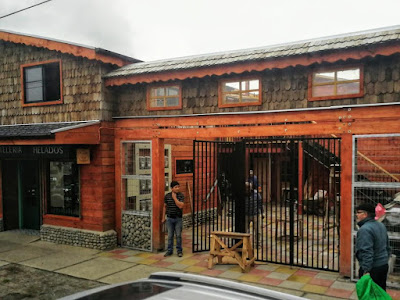
Puerto Varas is a fusion of German and Chilean culture. The architecture is evident of the influence of its past German "colonization". Many buildings which are made of timber with shingles distinguish them as of German architecture.
Shingles commonly used for building construction.
We were fascinated by the street vendors selling an array of local fruits and smoked mussels and clams. The ladies in our group went cuckoo when confronted with such abundance of cheap (even converted to Malaysia Ringgit) strawberry, raspberry, grapes and other exotic fruits!
*****************************************
Being in a region once dubbed a German "colony", it was no surprise that we were taken to the German Colonial Museum of Fruitillar before we returned to the cruise ship.

This 3-hectare museum site within the township of Frutillar is located to the west of Lake Llanhuique, a 30-min drive from Puerto Varas which is at the south of Lake Llanhuique.  The museum is more liked a mini park and is modeled to showcase the lives of early German settlers. This mini park has a Bell Tower, Water Mill (under renovation at the time of our visit), Country House, Workshop of the Blacksmith and a landscaped Garden. Items on display are collected from homes of early German settlers.
Display in the Country House.
A typical house in Frutillar.
We had expected to see Osorno Volcano from the western shore of Lake Llanhyuque. Again, the thick cloud prevented us to have a distinct view.
Typical Osorno viewed from the shore at Frutillar.
Courtesy of Cristian Alcazar C's photo..

Saturday, January 25, 2020

Valparaiso, Culture Capital of Chile

Our last stop in Santiago before we boarded the cruise ship on 21 December 2019 was Valparaiso, a colourful city of 300,000 inhabitants built "haphazardly" on the hillsides overlooking the Pacific Ocean. This is a historical seaport city and was declared a UNESCO World Heritage Site in 2003. Valpo as it is known to the locals is known as the heart of Chile's Bohemian culture. It is popular among tourists who come to see the many colorfully painted houses and old buildings of Spanish and French  architecture, many built precariously on hill slopes. There are many old church buildings with the traditional pointed spires.

The town grew soon after the influx of Europeans immigrants in the 19th Century. This port city was at its peak during the second half of the 19th Century. It was once known as the Little San Francisco or the Jewel of the Pacific because of its thriving status as a port. By the time the Panama Canal opened in 1914, its strategic importance as a port of merchant ships declined almost immediately.

Valpo is also famous for being the birth place of some of the celebrated sons of Chile. Among them are Augusto Pinochet and Pablo Naruda. Pinochet was the 29th President of Chile (1974 - 1990), a controversial leader who rose to become dictator and was said to be responsible for the executions and forced disappearances of over 3,000 people.

Pablo Naruda, a famous poet who won the Nobel Price for Literature in 1971 was also from Valpo.
Signature view of Valparaiso.
Cafe Turri where we had our lunch is acclaimed to be one of the top restaurants in Valpo for alfresco dining. The restaurant's open terrace offers a magnificent view of Valpo's neighborhood.
At the restaurant's terrace where we had lunch.

We were taken for a walk along the winding narrow streets in Concepcion Hill, one of the 42 hills in Valparaiso. The cobbled-stones-lined streets and old buildings with faded paint tell of Valpo's once vibrant past.
cobble stones-lined street.
Like all South American cities,  murals, graffiti, street arts as some like to call them are aplenty in Valpo. This may be one reason why Valpo is called the "Culture Capital of Chile". Artists are welcomed to paint on any empty wall and fence they can find provided permission has been given by the owners. 
***********************************************
There are many funiculars in Valpo installed to improve accessibility and enhance convenience for inhabitants and visitors of this hill side city. This one is at a stone throw distance from Cafe Turri.
This city prides itself as being classless where the rich live side by side with the poor. I believe that people who chose to live in such compact city with so many old wooden structures are aware of the principal risk, i.e fire. Barely four days after we visited this city, news of a Christmas Eve's fire was reported in the media. The fire destroyed some of the houses in the poor neighborhood (Read here). That fire was not the first and I believe it won't be the last either. But, the city's draw of tourists is unlikely to be dampened by such risks either.
Ranging fire flashed on the cruise ship TV on 
25 December 2019.