Saturday, January 25, 2020

Los Dominicos Artisan Centre, Santiago, Chile

Santiago in Chile is our transit point after Peru before we board the cruise ship. Considering the limited time, a visit to the Artisan Centre or "Centro Artesanal Pueblito Los Dominicos" as it is known locally is probably the best option. This handicraft centre with 140 workshops/outlets is a sort of a one-stop centre where traditional and contemporary crafts are on display and for sale. Craftsmen from all over Chile work on fabrics, stones, wood, copper, clay. leather etc to produce an array of jewelry, art pieces, paintings, photographs, sculptures, toys, souvenirs, bags. leather goods, musical instruments, antiques etc for sale. One can shop and watch craftsmen at work or just find a quiet spot and relax.
The original three wise monkeys: See No Evil,
Hear No Evil, Speak No Evil.
The new 4th monkey Sees Nobody, Hears Nobody and
Speaks to Nobody.
A typical workshop/outlet.

Huaca Pucllana, Lima, Peru

As our bus moved across the Central Lima in the morning of 19 December 2019, we passed next to a massive man-made hump created using mud bricks. We were told that this fully fenced up hump is Huaca Pucllana, ruins of a pre-Inca pyramid.

As someone who is interested in the ingenuity of people of bygone era in construction, I did some research soon afterword. This ruins left in the middle of Miraflores is pea-shaped and is aligned in a NE-SW direction.  It measures approx. 500 m long by 100 m-150 m wide. One end has been cut to make way for a road in the city.

This 1,500 years old pyramid is made of seven staggered platforms and is reckoned to be a shrine dedicated to a protector deity.

This structure is best appreciated from a drone view which someone has been kind enough to have uploaded on 18 December 2014 and further explained here.

Lima Peru, the Dry City of the World

As our bus traversed along the coastal road in Lima, I was confronted with a steep hill slope perched with high rise buildings built literally at the edge of the hill slope. I could imagine that it took both great engineering ingenuity and gut to make such engineering decision!

We were told by the local guide that millions of years ago, mud flow occurred from the inner highland toward the ocean. Then over time, waves and currents at the seafront eroded the front portion of the consolidated mud formation. That erosion created the steep slope as we see today. Peru has a unique topography and climatic condition. The coastal western strip is desert and inner eastern portion is lust jungles interspersed with numerous rivers. In between these two regions lies the famous Andes mountain range. The annual rainfall of Lima which is at the coast of the dessert region is only 16 mm. This is an extreme contrast compared with the 3,000 mm of rainfall in my home region. The water need of Lima is met by underground water plus water delivered by pipes all the way from dams and reservoirs at the inland forested regions.

Lima being a desert region, hence, the chance of rainwater saturating and destabilizing the hill slope is thus very minimal. With this climatic condition, it is understandable why Peruvian engineers dare erect high rise structures by the edge of the steep slope! Still, Lima's engineers are gutsy considering that Peru is a seismic active country! On 15 August 2007, an earthquake of 8.0 magnitude struck at a location 100 miles south of Lima killing over 500 people.
***********************************************
Yet, ignoring the risks, the top of the hill slope provides some of the most spectacular views of Lima coastline and the Pacific Ocean. Our lunch at one of the restaurants at Tanta de Larcoma was one of the best we had throughout our SA tour. It's the great varieties of dishes and freshness of the food combined with awesome views that distinguishes this particular gastronomic experience from the rest!
Tanta de Larcoma perched high on the slope
provides awesome view of the coastline and
the Pacific Ocean!
The restaurant on cantilever structure "hanging"
hundreds of meters precariously over the steep slope.
Overlooking the Pacific Ocean.

Friday, January 24, 2020

Qorikancha Museum, Cusco: A Lesson on Inca's Engineering Ingenuity

We had a brief glimpse of a bit of Cusco minutes before we had our lunch at the Green Organic. Many of the building design is a fusion between the Inca and the Spanish style and architecture. Peru, with a population of over 94% Catholics and Christians, it is not hard to see cathedrals and church buildings.
The Church of the Society of Jesus 
Cusco Cathedral.
************************************************
A visit to Qorikancha Museum is a lesson on Inca's engineering ingenuity and creativity. Qorikancha  or Coricanca in Quechua language means "Golden Courtyard". The predecessor of the site of the current Museum and Convent of Santo Domigo is the Temple of the Inca Empire built in the mid-15th century. It was said that the walls of the Temple at its apogee were lined with sheets of gold and stored with many treasures. When the Spanish conquered Peru, the Temple was ransacked, looted and destroyed. The gold was stripped and shipped to Spain. On the flattened temple site, the conqueror erected the Convent of Santo Domingo over the original foundation. The Spanish spent a century to build the Convent and Inca stonework was adopted for the construction of the new structure by the conqueror.

The huge courtyard
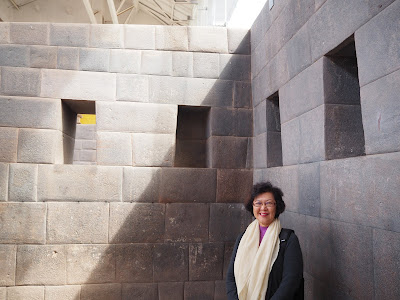
It is the mastery stonework that distinguishes Inca architecture. The walls of the chambers are built with the formed block stones which are perfectly fitted without any mortar. The precise tampered walls is typical of Inca trapezoidal architecture. The precision of the stonework is so perfect that one just could not tell where one block ends and the next begins.
An illustration of the chamber once lined with gold sheets.


Stones fitted without mortar.

Tapering of walls.
**********************************************
An array of block stones are on display with special formed grooves and holes.  These cavities ensure perfect interlocking of the of block stones to form the wall. Molten bronze is also poured into some of these grooves to provide rigidity against seismic or earthquake forces. 
*********************************************
An open field behind the complex was dug to reveal the original Inca structures.