Thursday, April 11, 2019

"Table Mountain" in Stanley, Tasmania

We decided to include Stanley into our travel itinerary because of the "Nut" which is advertised as one of the attractions in Tasmania. Most Stanleyians are proud of one of their sons, Joseph Lyons, who rose to become the Prime Minister of Australia  from 1932 to 1939. Visitors are welcome to pay a visit to the house where he and his family once stayed.

The Nut situated at the north-western coastline of Tasmania is a volcanic rock with a flattened top. It rises 143 m above the mean sea level. When I looked at this outcrop from a distance, I was instantly reminded of the Table Mountain which I saw in South Africa some six years ago. Unfortunately, I didn't manage to go to the top of Table Mountain because of bad weather at the time of my visit (Read here).
The Nut, Stanley, Tasmania.
Table Mountain, South Africa.
An ingenious way to capture the Nut and to promote Stanley!
To reach the top of the Nut, visitors can either walk the steep path all the way up or choose the easier option: the chair lift. Realizing that walking up may take between two and two and half hours, we chose the easier option.
Upon disembarking from the chair lift, it was followed by a leisure walk around the top of the Nut. From then on, it's looking at the landscape, flora and fauna and a 360 degrees views around the outcrop. We spent just under one and half  hours to cover the 2Km track.
For quite some time, we have opted not to use selfie stick because of the distorted and disproportionate face of the photographer. We have had no difficulty of getting stranger to take photo for us. In scenic spot, it is not difficult to find individuals, couples or groups who would love to have an "everybody in" photo. It just requires a bit of initiative by offering yourself to be their cameraman. In return, he or they are just too happy to act as your photographer.
*************************************************
Former residence of Former Prime Minister, Joseph Lyons.

In Search of Little Blue Penguins in Tasmania

Tasmania is renowned for its population of little blue penguins, the smallest species of penguin in the world. These endearing seabirds can be seen at various locations along the Tasmanian coastline, where designated viewing areas have been set up for penguin watching.

Unlike African penguins - which can often be observed in broad daylight (Read here) - the little blue penguins of Tasmania are much more elusive and shy. Being nocturnal by nature, they spend the day out at sea and only return to shore after sunset to nest in their burrows. At dawn, they head back into the ocean to feed. Because of this behavior, most visitors choose to watch them after dusk, when the penguins begin to emerge from the surf and waddle ashore in their charming, coordinated groups.

Little blue penguin. Photo downloaded from internet.
We didn't expect to see penguins in Bicheno until we saw a penguin signboard at the blowhole. The rocky blowhole area is in fact a popular spot for blue penguins watching.
Rocky beach front at at blowhole in Bicheno.

Soon after dinner on 30 March in Bicheno, we put on our thick winter clothing to prepare for a cold night out watching penguins at the blowhole vicinity. By the time we arrived, there were scores of people seated at various spots waiting for the penguins to appear.

Soon, twilight turned to pitch black sky. Growling noise from incoming penguins became more and more intense. When an intense growling noise was heard emanating just below the huge rock we were sitting on, I switched on the handphone torch light and zoomed onto the gap below the rock, I instantly caught sight of one penguin. But almost as soon as the handphone torch light landed onto the penguin, it ran off instantly. 

Without a torch emitting red light, it was futile to continue looking for penguins. We decided to cut short our search and headed back to our motel.
All dressed up and waiting patiently for penguins to appear!
*************************************************
After recounting our story about penguins search to Lucy, she and David led us to the Little Penguin Observation Centre, literally at the heart of Burnie town. At the viewing deck, there were volunteers from "Friends of Burnie Penguins" armed with red light torches who were ever ready to answer any question about this little creature!

In the end, we didn't see any "blue" penguin. All the penguins we saw were black camouflaged in "red"!
During April/May, penguins come ashore to build nests. Egg laying will be in July/October.

A Reminder of The Little House on the Prairie

Had we not joined the family trip to Melbourne initiated by Sam’s family, it would never have occurred to us to visit Lucy in Tasmania. Such a visit would have been unlikely in 2019, especially since we had last met Lucy barely eight months earlier in West Malaysia (Read here).

Finding Lucy’s house turned out to be far more challenging than expected, even with the aid of our Garmin GPS device. We were first led to one end of a vast stretch of farmland. Realising that we were lost, we stopped to ask a local for directions to our intended destination. Unfortunately, he had no idea where the address was and could offer no help. As a last attempt, we switched on our Waze app, which promptly redirected us to another location about five Km away. Yet even there, there was still no sign of a habitable house in sight.

Our final resort was to call Lucy on her mobile phone. Only then did we discover that we were actually standing at one corner of her extensive farmland. To our surprise, she mentioned that she could see our vehicle during our phone conversation. Moments later, she guided us safely to her residence. From this experience, we realised that GPS navigation, which relies strictly on an address, does not always lead you directly to a house situated within a vast expanse of farmland.

Our immediate reaction upon seeing her home was a vivid reminder of the television drama series Little House on the Prairie, which was popular from the late 1970s to the mid-1980s.

The house built on the top of a hill is accessible
via a 180 m long ascending straight road
tee-off from the main road. 

Casts of Little House on the Parries.
The farmland is blessed with a man-made mini dam, fed by stream water that flows year-round. Lucy’s husband, David, takes great pride in the quality of the water - so much so that a platypus has chosen to settle there and make it its permanent home. John was adamant that we visit the dam to catch a glimpse of this shy creature for ourselves. Although we managed to spot it through binoculars, it vanished instantly the moment we tried to move closer to the water’s edge.
Some time after we returned from our tour of Tasmania, Lucy sent us a WhatsApp message on 29 April with a video captured by David. To make up for our inability to see the large platypus during our visit, John was eager for us to watch the clip. The reason soon became clear - the big platypus had finally produced a baby platypus!
David was keen for us to see his farm. Almost as soon as we settled down upon our arrival to his house on 31 March, he ushered us to join him for a guided tour. He is well versed with every inch of the soil and every plant and tree. He took great pain to explain to us almost all types of vegetation we came across.
Pointing to the trees that he will harvest and sell one days 
for the timbers.
His greatest asset as he claimed is the Manuka trees grown in his farm. He confidently declared that his farm will be producing Manuka honey by the end of the year. He even invited us to come back to taste this world renowned brand of honey.

Talking about Manuka honey, David was clearly "annoyed" that New Zealand has "hijacked" the Manuka honey branding. He believes as many Tasmanians do that it is Tasmania which has the unique right to market Manuka honey because the honey harvesting and production was first documented in Tasmania!  
Some of his Manuka tress in his farm.
David's favorite companion, Bronte, the cattle dog.
Wombat's burrow in the farm.
The farm produces quality grass. David offers his land for cattle grazing for a fee and any excess grass is made into baled silage for sale.
Barriers of electric wires installed by John to keep
animals off the silage.
Lucy and David had proven to be great hosts and we enjoyed every moment of our stay in Burnie. But Lucy's mom clearly was not happy and she was keen to come back to Malaysia and Singapore to have a break from the cold weather.
Lucy's wedding in 1985 vs 2019
P/S Further update on baby platypus received on 26 May 2019

Wednesday, April 10, 2019

Deloraine, Tasmania

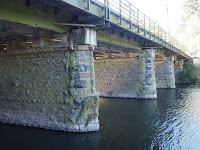
It was just over 1.30pm when we arrived at Deloraine after leaving Campbell Town. We were instantly struck by its picturesque landscape and the old bridges supported by antique-looked piers. Like any city blessed with a river, Deloraine's beauty is undoubtedly enhanced by the clear and unpolluted Meandering River.

We didn't stay long in Deloraine because most shops were closed on Sunday. We also couldn't stay long because we needed to move on to our final destination before nightfall.