Saturday, September 22, 2018

Lessons Learnt About Rubbish in Europe

Spittelau Waste Incinerator Plant in Vienna, Austria is one of the destinations of the technical tour to Eastern Europe.

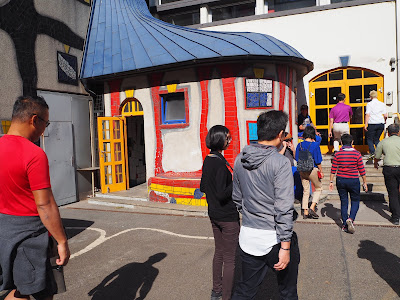
The first impression of the plant is that it looks more like an amusement park for holiday makers rather than a dumpsite for rubbish disposal. Each year, it processes 0.25 million tonnes of household waste and produces 120,000 MHh of electricity, 6,000 tonnes of scrap iron and 60,000 tonnes of clinker, ash and filter cake. Heat generated is enough to heat up more than 60,000 homes.

European Union is targeting to cut down rubbish incineration by increasing recycling. By 2050, Europeans are expected to recycle 70% of urban waste and 80% of packaging waste. By 2025, EU is pushing to ban sending recyclable waste to landfill and to have 30% reduction in the amount of food thrown away.
*************************************************
Inside the Incineration Plant
Group photo at the entrance to the Incineration Plant
*************************************************
In Ljbuljana, Slovenia, we had difficulty finding rubbish bins to discard bits and pieces of waste. Rubbish bins by the road side for local residents are all locked up and they can only be opened by the locals who have the access cards. We noticed there are four categories of bins and each for a specific type of waste - organic, residual, paper and glass. We were told that every household is allowed to deposit a certain load of waste into the bins weekly. There is clear objective to cut down solid waste and to encourage recycling. 
Bins for organic waste and residual waste
Bins for paper and glass
***********************************************************
Nearer to home, I remember at one time in the late 80's, we visited the "Smokey Mountain" landfill which was a recommended itinerary of a Manila tour. Visitors were shown the massive shanty housing colonies that mushroomed around the rubbish dumpsite. At one time, 30,000 people made their living from picking trash from landfill's rubbish.

Today, shanty slums are replaced by low cost housing. Recycling is now a government policy and "scavengers" are now required to obtain permits to enter controlled dumpsites to pick trash for recycling.
*************************************************
Now that we have first hand knowledge about Spittelau Waste Incinerator Plant in Vienna, the next question will be: Can Sabah have an incinerator plant of the like? This is probably too premature to consider since the mind sets of people on rubbish handling and disposal have yet to change.
Beach front in KK next to the the tower block where the
Chief Minister Office in Sabah is housed!

River Danube - An Energy Source

Whenever River Danube was mentioned, "The Blue Danube Waltz" by Johann Strauss came to mind. On 9 September 2018, our group visited the Danaukraftwerk Fredenau Hydropower Station in Vienna. Rather than be confronted by the romantic and lovey-dovey scene of this river that my mind has been programmed to imagine, I saw River Danube's sheer might in its capability to generate electricity from hydropower. This station alone is capable of generating electricity for two third of the 1.6 million of the Lower Austria which encircles Vienna.

River Danube passes through 10 countries: Germany, Austria, Slovakia, Hungary, Croatia, Serbia, Bulgaria, Romania. Moldova and Ukraine. In Austria alone, the river powers nine hydropower stations. EU of which Austria is a member is moving fast towards increasing the use of renewable energy.
River Danube seen from the access bridge to the
 power plant.
We descended to the bottom of one of the
 turbines below the river bed of Danube.

Schonbrunn Palace, Vienna, Austria

Schonbrunn Palace has a long history that dates back to mid-16th century. The area was originally used as royal court's recreational hunting ground. The Schonbrunn Palace in its present form was built and remodeled during the mid-18th century during the reign of Empress Maria Theresa who received the estate as a wedding gift. Holy Roman Emperor, Francis 1 who married Maria Theresa was the founder of the Habsburg-Lorraine dynasty. This couple had eleven daughters and five sons. But only ten survived to adulthood. Her reign as Archduchess of Austria, Queen of Hungary and Croatia lasted forty years from 1740 to 1780. In those days, political alliance, inter-state peaceful co-existence and even expansion of empire were forged by marriages. It was for these purposes that royalties would have as many children as possible.

I had no knowledge of who Franz Joseph was when I set foot on Franz Joseph Glacier in New Zealand on 23 February 2016. In the tour of the Schonbrunn Palace, we were given a better picture of this man. 

Franz Joseph 1, the last monarch of the Habsburg-Lorraine dynasty was born in Schonbrunn Palace in year 1830. He spent his entire life in this palace. He was an illustrious king who ruled for 68 years until his death in 1916, aged 86. He ruled at a time when his state started to rise against monarchy and clamored for greater freedom and autonomy. His rule was punctuated with personal tragedies. He saw the execution of his brother, Emperor Maximilian of Mexico in 1867, the suicide of his only son and heir, Crown Price Rudoff in 1889, the assassination of his wife, Empress Elizabeth in 1898 and finally the assassination of his nephew, Archduke Franz Ferdinard in Sarajevo which triggered World War 1.
The interior of the Palace is a display of life styles of a family who lived in opulence and extravagance. Unfortunately, no photography was allowed inside the Palace to capture some of these scenes. 

Was Franz Joseph 1 a victim of his time? Would he be absolved because he inherited a life style that was passed down to him?

But no matter how history is to judge the Habsburg-Lorraine dynasty, the fact remains that the generations after them in Austria have benefited from them, at least the tourism money earned from visitors to these "attractions" has contributed to some extent the nation's coffer!
***************************************************
Have subsequent governments of states learnt anything out of this sort of tragedy? Definitely not. Dynasties come and then disappear, many for the same reason. Power corrupts and corrupts absolutely. Malaysia is no exception.

Friday, September 21, 2018

Cesky Krumlov Castle, Czech Republic

Cesky Krumlov is blessed with a river and hills. The Vitava River that cuts across the city and rocky hill on steep slope by the side of the river accentuate the beauty of this place.  Literally, everyone who visits Czezh Republic would not miss spending half a day or so in this city. Ever since the city's elevation to World Heritage Site in 1992, visitors are increasing by leaps and bounds. The city which has a population of 14,000 hosts some 1.2 million visitors last years.

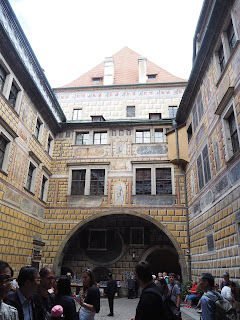
Many come to see the castle, castle tower and chateau that perched on rocky hill overlooking a picturesque old city. The castle which dates back to 1240 has over the years undergone numerous restoration and renovation. It's a mixture of Gothic, Renaissance and Baroque design.
The beauty of Cesky Krumlov Castle and its surrounding
 is best appreciated from the air.
Pedestrian bridge across Vitava River.
A group photo in the old city with the castle
tower at the far background.
Many buildings in the old city are of Baroque design.
Making our way to the Castle perched on top of the hill.
Castle external compound. No photography once inside the main castle.

A Session on Firearms in Prague

Leisure shooting to cater for tourists is popular in Prague. We did not miss this opportunity and many among the tour group members signed up for a shooting session. The shooting was held in one of the many shooting ranges that are opened for leisure shooting.

There are a great variety of guns including the most iconic ones we have seen in movies! AK47 Kalashnikov, M16, Dragunov, Magnum. This list goes on.

None in the group has handled nor shoot from a gun before. It was a one in a lifetime experience for the group members. Instant briefing on weaponry safety and instruction training is given by professionals once we assembled at the range. However, because of the need to rush back to Prague city to catch the Swan Lake Ballet performance, our session had to be cut short. All participants were given time to shoot at targets using AK47 rifles and Magnum revolvers.

After the shooting exercise, we discovered that shooting is indeed not an easy thing. Probably, the trickiest part is to handle the recoil upon pulling the trigger.
The shooting session ended with a beer session!