Wednesday, September 17, 2014

Bathampton

Bathampton, a semi-rural village on the outskirts of Bath, held a few unexpected surprises for us.

One notable site is St. Nicholas Church, an Anglican church originally built in the 13th century. It underwent significant alterations in the 15th century, including the addition of a tower. The church is best known as the final resting place of Admiral Arthur Philip, the first Governor of New South Wales, Australia, who was buried there in 1814.

Visitors interested in the early history of New South Wales will find the "Australia Chapel" in the south aisle especially meaningful. This section of the church contains memorials and informative displays dedicated to Admiral Philip and his legacy, making it a quiet but significant stop for those tracing Australia's colonial beginnings.

***********************************************************
The Kennet & Avon Canal skirts the edge of Bathampton and lies just across the road, within easy walking distance from the church grounds. This historic waterway stretches across southern England, covering a total length of 87 miles (140 km). It comprises two navigable rivers - the River Avon and the River Kennet - linked by a central canal section. Although technically only the middle part is a canal, the term "Kennet & Avon Canal" is commonly used to refer to the entire waterway.

Beginning in Bristol, the route follows the River Avon to Bath, before continuing via the man-made canal to the River Kennet at Newbury, and ultimately reaching the River Thames at Reading. Along its course, the waterway includes an impressive 105 locks, a testament to the engineering prowess of its time.

As we stood nearby, it did cross our minds that on a future visit to the UK, a journey aboard one of the traditional narrowboats that navigate this canal might be a delightful way to explore the English countryside at a leisurely pace.

***********************************************************
Bathampton will also be fondly remembered for its excellent beer and hearty pub food. We spent two enjoyable evenings at The George Inn, a charming and historic riverside pub located just a stone’s throw from St. Nicholas Church. With its cozy atmosphere, local ales, and classic British fare, it offered the perfect setting to unwind after a day of exploring the village.
***********************************************************
Another unexpected surprise came as we left Bathampton for Tetbury on 17 August 2014. To our delight, we encountered a quaint toll bridge where we had to pay a £1 fee to cross. This charming arched bridge, constructed from the iconic Bath stone in 1872, spans the River Avon and still retains much of its historic character. The road across the bridge is a single track, controlled by a "give way" sign, requiring drivers to take turns crossing - a gentle reminder of a slower, more graceful era of travel.

A Day in Bath

It was already evening by the time we checked into Lindisfarne Guest House in Bath on 15 August 2014. Nestled in the charming village of Bathampton, Lindisfarne is a delightful house set within well-kept gardens, conveniently located just off the roadside. The guest house offers a peaceful retreat while being only 1.5 miles from the historic centre of Bath. This iconic city, situated in Somerset in the southwest of England, is renowned for its Georgian architecture, Roman Baths, and rich cultural heritage.
************************************************************
Although we had a car, we were advised against driving into Bath city centre due to the high parking charges. Taking that advice, we opted for a taxi instead, which turned out to be a convenient and hassle-free way to get into the heart of the city.

Bath, designated a UNESCO World Heritage Site in 1987, attracts nearly 4 million day visitors and around 1 million overnight guests each year. Its fame dates back to ancient times, largely due to the natural hot springs discovered in the area. By AD 60, the Romans had transformed the settlement into a spa town, constructing elaborate baths and a temple dedicated to the goddess Sulis Minerva.

To explore the city, we took a ride on a double-decker sightseeing bus. It was an excellent way to quickly gain an overview of Bath’s rich history while enjoying panoramic views of its stunning Georgian architecture and scenic surroundings.

The decision to impose high parking rates has proven wise for a city so dependent on tourism. By discouraging excessive car use, Bath preserves its charming atmosphere and allows visitors to explore with greater ease and safety - free from the congestion that often plagues other historic cities.

*************************************************************
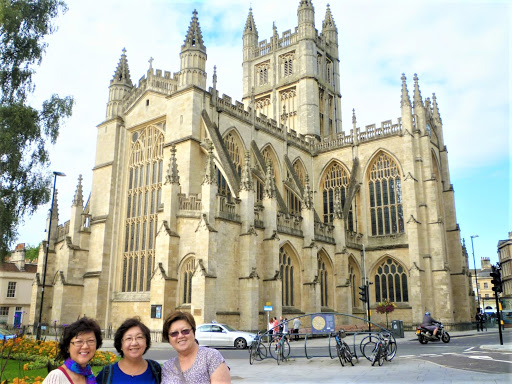
We visited the Abbey Church of St. Peter and St. Paul, more commonly known as Bath Abbey. This magnificent Gothic structure, with its striking fan-vaulted ceiling and stained glass windows, stands as one of the city’s most iconic landmarks. Designed in the shape of a cruciform, the church can accommodate around 1,200 people and serves multiple purposes - from regular religious services to secular civic ceremonies, concerts, and public lectures.

During our visit, the atmosphere was particularly special, as a wedding ceremony had just concluded. The lingering floral arrangements and joyful mood added a unique charm to our experience, offering a glimpse into how this historic space continues to be a living part of the community.

************************************************************
The River Avon winds its way through the heart of Bath, adding to the city’s timeless charm. We took a leisurely river cruise along its tranquil waters, which offered us a different perspective of Bath - one that revealed its picturesque scenery, elegant Georgian architecture, and peaceful riverside views. Gliding past historic bridges and lush greenery, the cruise was a relaxing and scenic way to experience another side of the city beyond its busy streets and landmarks.
While seated inside the boat, I happened to glance upward - and a chill ran down my spine as I took in the sight of buildings perched seemingly precariously on cantilevered supports above the riverbank. It was both awe-inspiring and unsettling. The builders and engineers of a bygone era were clearly both bold and highly skilled. Their craftsmanship has stood the test of time, with structures that appear to defy gravity yet remain firmly intact to this day.

One particular bridge we passed over the River Avon reminded me of the old London Bridge, where buildings once lined either side. Here, a row of small units has been constructed along one side of the bridge - modest in size but full of character. These spaces now house quaint souvenir shops and cosy eateries, catering to the steady stream of tourists drawn to Bath’s historic charm.

Stonehenge

We drove to Stonehenge from Oxford, making a stop there on our way to Bathampton. Located in Wiltshire, approximately eight miles north of Salisbury, Stonehenge is one of the most iconic and mysterious prehistoric monuments in the world.

The earliest phase of Stonehenge dates back around 5,000 years, when it served as a burial site for cremated remains. Around 2,500 BC, the monument underwent a major transformation with the erection of its famous standing stones. Two distinct types of stones were used: the massive Sarsens and the smaller Bluestones. The Sarsen stones, weighing between 20 and 30 tons each, were arranged in two main patterns - an outer circular ring and an inner horseshoe formation. Between these were positioned the Bluestones in a double arc.

It is truly mind-boggling to contemplate how prehistoric people managed to transport and erect such colossal monoliths without modern machinery. The Sarsens were quarried from Marlborough Downs, about 20 miles north of Stonehenge, while the Bluestones - each weighing up to 4 tons - were believed to have been sourced from the Preseli Hills in Wales. Archaeologists suggest that the Bluestones were transported by a combination of sea and river routes along the Welsh coast, followed by an overland journey to the site.

The entire process - from quarrying to transportation and final erection - was achieved solely through human ingenuity and determination. Stonehenge stands not just as an archaeological wonder, but as a testament to the skill, strength, and vision of ancient civilizations.

                                                                                 Photo: Courtesy from website.

Tuesday, September 16, 2014

Oxford

Immediately upon reaching Oxford from London on 15 August 2014, we boarded the double-decker bus to tour this city. Through the audio aid, we were fed with a fair amount of information about this university town.

There are over 22,000 students, 11,770 undergraduates and 9,850 graduate students. 62% of graduate students come from outside UK. Academic staff come from almost 100 different countries and students from more than 140 countries.

With the short time allowed for the visit of Oxford, we did not manage to enter any of the university buildings.
Though we may have the impression that many of the exceptional and brilliant students are Asians and Chinese, the actual enrollment of both Asians and Chinese is in fact just over 2% of the total intake.
 
For Harry Potter's fans, it was said that many of the movie scenes were shot in this University. The Great Hall of Christ Church College was quoted as one of the locations. But in actual fact, the filming wasn't done in the Great Hall at Christ Church. The hall was copied and rebuilt as a set, but it looks as identical (as one would expect from the art director team).

The Greenwich Meridian

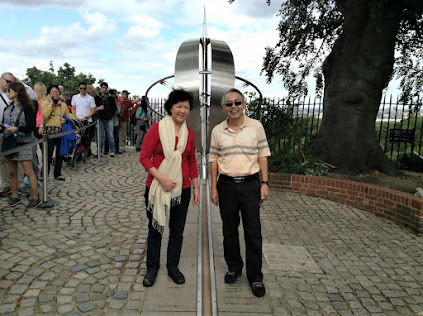
On 13 August 2014, I stood at the Greenwich Meridian, with one foot in the Eastern Hemisphere and the other in the Western - straddling the very line that divides the world longitudinally.

This Zero Degree Longitude, established at the Royal Observatory in Greenwich, England, was defined by Sir George Airy in 1851. However, it wasn’t until the International Meridian Conference held in Washington D.C. in 1884 that the Greenwich Meridian was officially recognized as the Prime Meridian of the world. At that conference, 22 nations agreed to adopt it as the global reference point for timekeeping and navigation.

Although the Greenwich Meridian is an imaginary line, it plays a critical role in geography and global coordination. In addition to the United Kingdom, it also passes through seven other countries: France, Spain, Algeria, Mali, Burkina Faso, Togo, and Ghana.

Kota Kinabalu, located at approximately 116.0782 degrees east longitude, should theoretically be 7 hours and 45 minutes ahead of London based on its geographical position. However, for the sake of national consistency, Malaysia has standardized its time zone to be exactly 7 hours ahead of London’s time (GMT+8), simplifying coordination across the country.

 
It costs 7 pounds to stand on this line within the fenced compound.
However, visitors can also choose to have photo taken free of charge next to a vertical line outside the fenced compound. We did both.