Tuesday, September 07, 2021

Tabgha

This blog is a continuation of the recent entry on the Tour of Israel in late May to early June 2014 (Read here). 

***************************************************
Tabgha became a pilgrimage site because of a rock outcrop believed to be where Jesus prepared a meal for some of his disciples after his resurrection. Jesus was crucified and buried in Jerusalem. After his resurrection, this is one of the places he appeared. Tabgha, is a mere 3 Km away from Capernaum dubbed the town of Jesus, where he had spent much of his life (John 21:1-17). Tabgha at the northern shore of the Sea of Galilee is 125 Km away from Jerusalem.

Quote
Early in the morning, Jesus stood on the shore, but the disciples did not realize that it was Jesus. He called out to them, "Friends, haven't you any fish?" "No," they answered. He said, "Throw you net on the right side of the boat and you will find some." When they did, they were unable to haul the net in because of the large number of fish. Then the disciples whom Jesus loved said to Peter, "It is the Lord!" As soon as Simon Peter heard him say, "It is the Lord," he wrapped his outer garment around him (for he had taken it off) and jumped into the water. The other disciples followed in the boat, towing the net full of fish, for they were not far from the shore, about a hundred yards. When they landed, they saw a fire of burning coals there with fish on it, and some bread. Jesus said to them, "Bring some of the fish you have just caught." So Simon Peter climbed back into the boat and dragged the net ashore. It was full of large fish, 153, but even with so many the net was not torn. Jesus said to them, "Come and have breakfast." None of the disciples dared asked him, "Who are you?" They knew it was the Lord. Jesus came, took the bread and gave it to them, and did the same with the fish. This was the third time Jesus appeared to the disciples after he was raised from the dead. 
Unquote
************************************************
According to the story, it was at the breakfast that Jesus said to Peter, "Feed my sheep.", after asking him three times, "Do you love me more than this?" 

In commemorating the legacy of Peter, the Church of Primacy of St. Peter was built at this very location in 1933 over an earlier 4th century church. The bedrock outcrop believed to be where Jesus served the breakfast is now inside the Church next to the altar.
Briefing and getting ready to visit the Church.
Church of Primacy of St. Peter. Captured
from Google Map.
Side view of the Church taken on 28 May 2014
during our visit.
Rock outcrop inside the Church.
**********************************************
After the visit to the Church, many took a stroll along the shore of the Sea of Galilee where Jesus was believed to have walked. Suddenly, someone suggested throwing stones over the water surface. Was it an instant fun act or a ritual to mimic what many do at the Sea of Galilee?

Much later, I discovered that throwing stones has significance to some people. Each piece of stone may represent a long-held unforgiveness toward family members or someone. Some of the stones signify unfulfilled hopes and dreams. Some throwers consider the ritual to be a release of emotional and spiritual burden from their hearts. To some, the shore where Jesus once walked should be the most appropriate place to finally let go.
At the shore of the Sea of Galilee.
Throwing stones at at the Sea of Galilee.

Monday, September 06, 2021

St. Peter's Fish

A pilgrimage tour of the Sea of Galilee normally ends with a meal of St. Peter's fish either for lunch or dinner.

Tilapia which is called St. Peter's fish in Israel is a common freshwater fish found in the Sea of Galilee since Jesus' time. It is still one of the favourite fish eaten by the Israelites today. It is called St. Peter's fish because of long passed down story that it was Tilapia that were caught by Peter and fed to the people in Tabgha, the home town of Peter. Tabgha (Read here) is an ancient town situated at the northwest of the Sea of Galilee a short distance from Capernaum.

A meal of St. Peter's Fish.
In the story recorded in Matthew 14:15-21 about the miracle of the feeding of 5,000 with two fish and five loaves of bread in Tabgha by Jesus, it is generally acknowledged that the two fish are Tilapia. 

Not surprisingly, a Church was built in Tabgha by the faithful to commemorate this miracle. The Church of Multiplication at Tabgha has a mosaic of two fish and five loaves of bread. The fish look similar to Tilapia. Unfortunately, a visit to this Church was not in our itinerary.
The mosaic in the Church of Multiplication, Tabgha.

Sunday, September 05, 2021

Sea of Galilee

The Sea of Galilee is one place Jesus is closely associated with in his ministry on earth. This is where he grew up, began his ministry, preached to the crowds and performed numerous miracles. He walked on the water, calmed the storm and made Peter and Andrew into fishers of men.

The Sea of Galilee is a freshwater lake with a surface area of just 166Km2. It is the lowest freshwater lake on earth with surface water level of approx. 210m below mean sea level. Its maximum width is 13Km and an average depth of 25Km.

Brochure received at the boat tour.
It is said that the wooden boats used by pilgrims to sail on the Sea of Galilee are fashioned based on a 1st century boat unearthed in the mud of the Sea of Galilee.
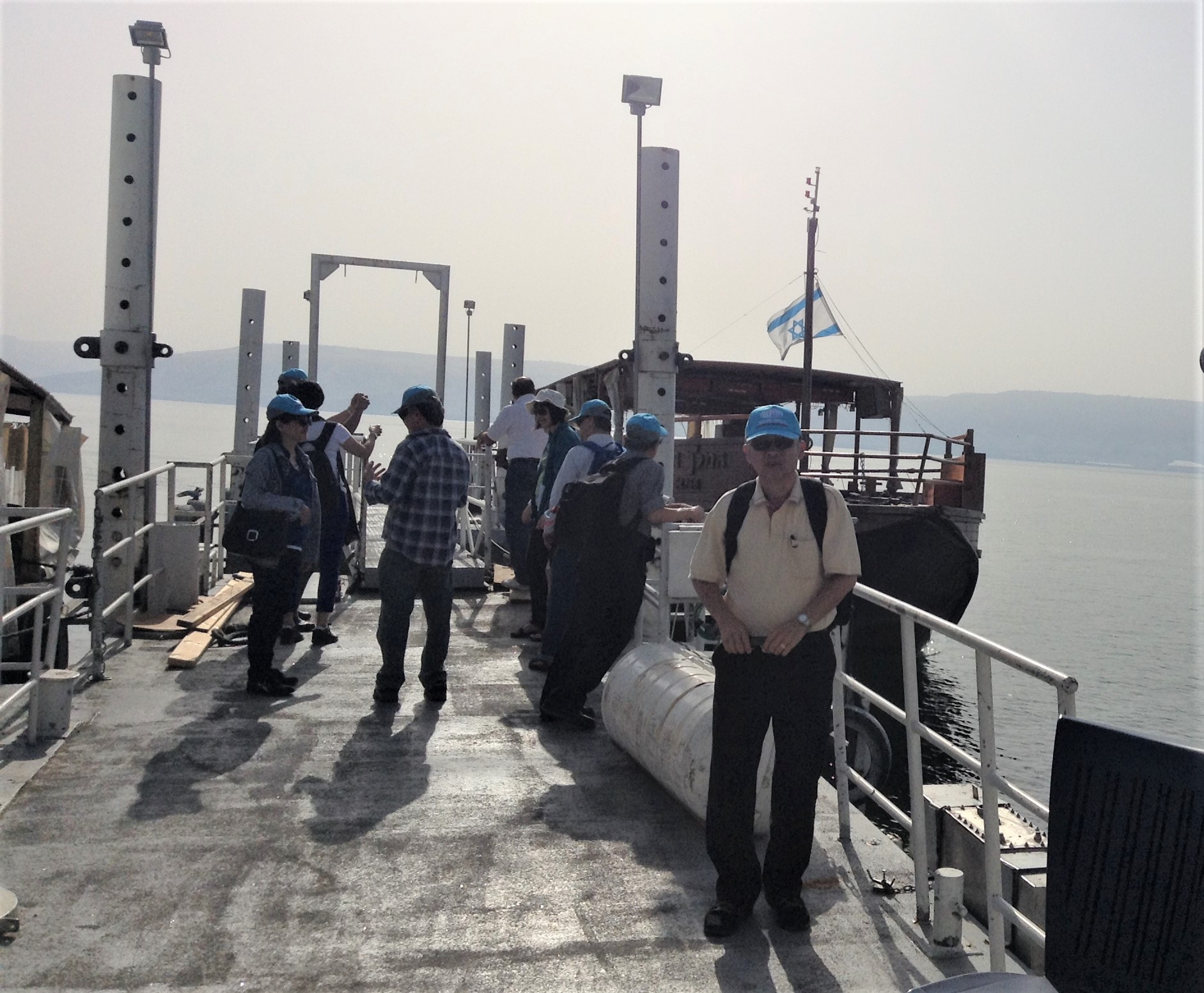
At the jetty just before boarding the boat.
The jetty.
***************************************************
A time of celebration with singing and dance in the boast.
Hill overlooking the Sea of Galilee.
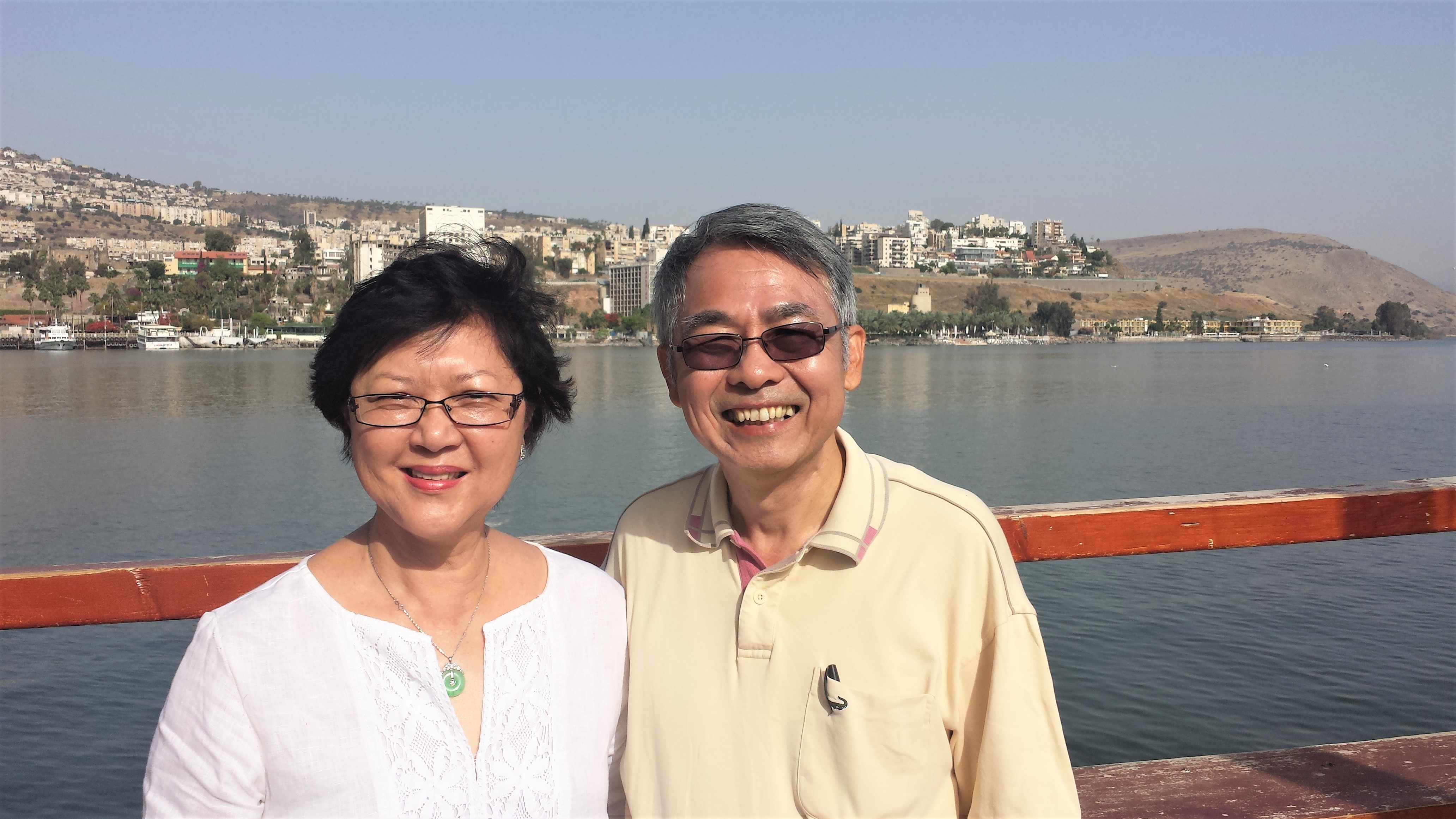
Some of the tour members.
With the tour leader, Stephen Tee.
Pilgrims from every country have the opportunity to see their country's flag flying with the host nation's flag in the boast. But this scene of a flag of Malaysia placed side by side with the flag of Israel can be controversial to some people in Malaysia.
**************************************************
After the sailing on the Sea of Galilee, we stopped at Yigal Allon Centre. This is where the ancient wooden boat unearthed from the mud of the Sea of Galilee is kept.

Saturday, September 04, 2021

Mount Tabor

This blog is a continuation of the recent entry on the Tour of Israel in late May to early June 2014 (Read here). 
**************************************************
We checked out from the hotel in Tiberias on 29 May 2014 and headed to Bethlehem. On the way, we stopped at Mount Tabor.

Mount Tabor stands conspicuously as a huge hump at the north of the huge plain of Jazreel Valley. Hiking this mountain may take one to five hours. With the peak elevation of 575m, our Signal Hill where the State Governor's official residence is sited (220m) pales in comparison. Mount Tabor had witnessed countless of wars fought at the Jazreel Valley.

A direct reference to Mount Tabor is found in Judges 4:6 - She sent for Barak son of Abinoam from Kedesh in Naphtali and said to him, "The Lord, the God of Israel, commands you: "Go, take with you ten thousand men of Naphtali and Zebulun and lead them to Mount Tabor".

Mount Tabor captured in Google Map.
To the Christians, it is the Mount of Transfiguration rather than Mount Tabor that rings the ears. A less direct reference to this mountain is found in Matthew 17:1-17. This is the story of the transfiguration of Jesus -  "After six days Jesus took with him Peter, James and John the brother of James, and led them up a high mountain by themselves....."

The high mountain referred to in the story is by tradition believed to be Mount Tabor. Mount Tabor, being a place closely associated with both the Old Testament and New Testament has been a pilgrimage site since the 4th century AD. Two Church buildings now occupy the peak of Mount Tabor: the Church of Transfiguration and the Eastern Sanctuary of the Orthodox Church. The former is more well known and is a Roman Franciscan Church which was built between 1919 and 1924.

On Mount Tabor, we visited the Church of Transfiguration.
Photos of the Church of Transfiguration captured with courtesy of BibleWalks.com
As we walked around the vicinity of the compound of the Church of Transfiguration, we saw a group of Israel Defense Forces (IDF) patrolling the surrounding area of the hill. This fully armed soldiers were very friendly and were ever ready to pose for photographs.

For the Israel Government to station IDF at this location, there must be strategic importance of the place. The northern boundary of the Palestinian West Bank and the western boundary of Jordan is mere 20Km away. The intersection of the north-south and east-west highways is also close by. Mount Tabor is therefore ideal as a watch tower to see any unusual movements around all sides.
It was said that much of the trees around the hill slopes were cut down during the Ottoman period. Realizing the problem, significant effort has been taken to reforest the area in the past 100 years. 
Lush pine forest now lines the hill side.
Looking across the south and southwest from Mount Tabor, one can see the huge plain known to many as Magiddo or Armageddon - the plain where the final battle will be fought!