Friday, June 01, 2018

San Miniato

After our tour of the Leaning Tower of Pisa, we drove 50Km eastwards to a hilltop old town - San Miniato. By the time we arrived, it was early afternoon of 17 May. The weather was cool and sunny, perfect for a walk-around of this at least 10th century old city.
Typical roadway built to the edge of the
buildings without pedestrian walkway.
A short cut to the Cathedral of Santa Maria Assunta & San Genesio situated at an higher platform is through this flight of stairs through an old building.
At this platform, we got a glimpse of another section of the hilltop town extending outwards like tentacles or arms of  an octopus along ridges of a series of hills.
At the distant background is San Miniato Basso founded on the plain below.
*************************************************
The Cathedral of Santa Maria Assunta & San Genesio looked rather plain from the outside. The interior however is unexpectedly exquisite.
The church campanile or clock tower.
We walked along a long flight of stairs to reach the summit at +192m elevation to see the Federick Tower originally built by Roman King Federick II during the 13th century. The sad part is that this building was used to imprison King Federick II's Chancellor, Pier delle Vigne falsely accused of committing lese majeste. He was blinded and he soon committed suicide, a sad story.

Leaning Tower of Pisa

Foundation engineering is a subject that can either bless or break the design engineer. If the foundation designer of the Tower of Pisa is practising today, the tilting of such prominent building would probably have cost him his practising license.

It is a known fact that the tilting of the Tower was caused by inadequate foundation on ground too soft on one side to adequately support the weight of the building structure. Since the tower complex took some two centuries to complete (12th to 14th), the designer never lived to see the lasting impact of his faulty design.

The Architect would have wanted the visitors to come and see the main Cathedral and the Baptistery of which all his major effort was put in. In the end, it is the bell tower, considered a minor building that people are drawn to.

In this particular case, the faulty design turns this minor structure into an iconic building drawing millions to the city of Pisa. The draw of tourists to this structure in Italy is no less significant in comparison to the Eiffel Tower in France. 

Each year 1 million visitors come to see this leaning tower. When I enter the only public toilet in the compound which charges 80 cents Euro per entry, I could imagine how the toilet operator would beam and laugh all the way to the bank.  

It is unimaginable that the faulty design has turned out to be a revenue earner and a blessing to Italy. For this, the designers deserved to be forgiven for their mistakes and be nominated to the hall of fame! 
Pisa Cathedral.
Pisa Baptistery of St. John.

Lucca, Tuscany

On 16 May 2018, after visiting the birth place of Da Vinci, we drove 55 Km westward to Lucca. Lucca is an ancient and medieval town first founded by the Romans in 180 BC. Julius Caesar, Pompey and Crassus once met here in 56 BC to affirm their political alliance.

Lucca is famous for its Renaissance-era walls first built by the Romans. By the 11th to 12th century, a second set of wall was built integrating with the original old wall. The top of the wall is now popular among pedestrians and cyclists.
On top of the old wall, we caught a glimpse of the bell tower of San Martino, the famous Lucca Cathedral

Lucca is also a one of the main cities of Arts and sometimes being referred to as the "City of 100 Churches".  The fortified wall had managed to preserve many of the medieval churches, towers, bell towers and palaces of great beauty and elegance.
San Michele in Foro, a Roman Catholic Basilica Church.
Basilica of San Frediano, a Church of Romanesque
design and named after the Bishop of Lucca
of the first half of the 6th century.
We did what all visitors like to do. We walked around the old streets and alleyways of this historic city centre to get a feel of the ambient and traditions inherited from those yesteryears.
Old tinny shops packed with all kinds of mercantile, baked goods, souvenirs.........
**********************************************************
The tour of Lucca ended with a late lunch at Buca di Sant' Antonio, reckoned to be one of the best restaurants in Lucca.

Da Vinci, Tuscany

In 2017, a painting of Jesus Christ by Leonardo da Vinci, named "Salvatore Mundi" was sold in an auction for $450 million (RM1.8 billion). There was intense speculation on the buyer's identity after it was known that an anonymous buyer has bought the painting. It is now known that the painting is kept in the newly opened Louvre Abu Dhabi. It was after all the Arabs who are prepared to pay such a mind-boggling and colossal price!
Salvatore Mundi sold for a whopping 
RM1.8 Billion.
Courtesy from web site.
On 16 May 2018, I had a chance to visit Da Vinci's birthplace, Casa Natale di Leonardo in Vinci, Tuscany. Our farm stay is less than 5Km away from Casa Natale di Leonardo (the birthplace of Leonardo). The trip to Tuscany would have been incomplete if we had not made Da Vinci's birthplace one of our destinations. 
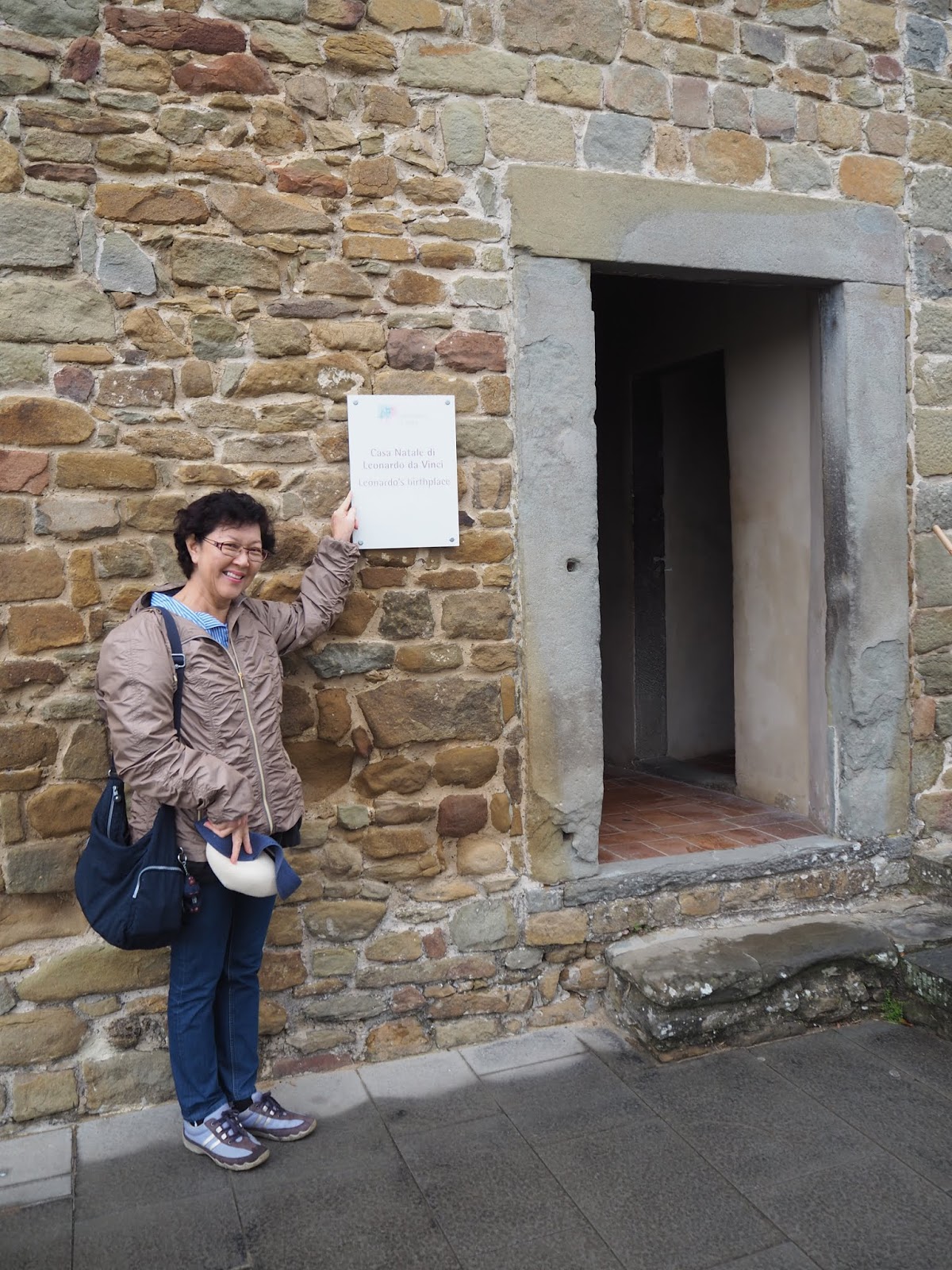
Vinci in Tuscany would have been just an obscure little town had Leonardo not been born there. Anyone can be named Leonardo. But there is just this one and only Leonardo from Vinci that everyone is familiar with. Leonardo and da Vinci are so intertwined that it is "da Vinci" rather than Leonardo that would unmistakably lead you to think of this iconic individual. 

As I discover later, Vinci is now named after so many things - streets, squares, parks, airport, schools, colleges etc. There is even a crater in the moon named "da Vinci". 
Da Vinci, a genius, born and  raised in a typical 
modest environment. 
Painting of The Last Super
Coat-of-Arms of the Da Vinci family.
We caught a glimpse of the little town of Vinci which is just 2Km southwest of the birthplace of Leonardo.
*************************************************
Late afternoon of the next day on 17 May 2018, on the way back to our farm stay after visiting Pisa and San Miniato, we made a detour to Museo Leonardo da Vinci (Leonardo da Vinci Museum) in Vinci town itself. This is a place where replicas of Leonardo da Vinci's many inventions are displayed - machines for war, hoists, mechanical devices etc. 

To me, the paintings of "The Last Supper" and "Mona Lisa" somehow almost always lead us to think of Da Vinci. To me, he is remembered more as an artist than an inventor all along. I was surprised to see in the museum such large collection of exhibits all attributed to him! Leonardo da Vinci is undoubtedly a genius, he was indeed a man with a mind way ahead of his time.
Vinci town viewed from museum roof top.