Friday, January 24, 2020

Machu Picchu, Peru

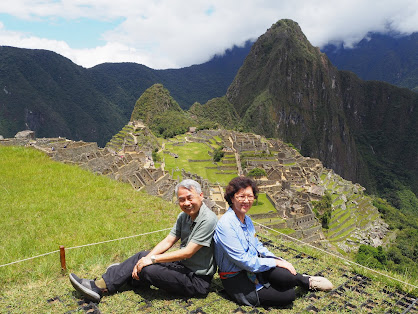
We finally made it to Machu Picchu at approx. 10.30am on 17 December 2019. At that moment, we had probably the same feeling as Hiram Bingham when he was led to rediscover this mysterious "Lost City of the Inca" deep in the jungle on top of the mountains in Peru on 24 June 1911. Soon after, serious investigation, study of the ruins and analysis of the relics and artifacts commenced. Two years later and through the National Geographic, Machu Picchu was brought to the attention of the world. Ever since then, its enigma has become the fascination and imagination of many adventurers, trekkers, thrill seekers and travelers just like us. In 1983, this site was declared a UNESCO World Heritage Site. In 2007, it was voted as one of the New Seven Wonders of the World.

Machu Picchu which means "Old Mountain" in Quechua language is reckoned to be built around the 15th century. It was abandoned just 30 years later. This Inca citadel built high in the Andes Mountains above the Urubamba River valley is the tangible evidence of the reign, sophistication and achievement of the Inca Empire. 
Machu Picchu as seen on 17 December 2019.
An illustration of the original Machu Picchu in the book
entitled "Presenting Machu Picchu"
by Saydi M Negron Romero.
14 out of 32 made it to the upper level of the complex.
********************************************
It is still a mystery why this ridge of the mountain was chosen for the construction of a citadel consisting of palaces, temples, plazas and dwelling houses. Certainly, the location is ideal for the elites who wanted a safe haven with year round awesome panoramic view surrounding the hideout! It's surrounded on three sides by Urubamba River at the valley below and sheltered by an imposing peak at the north.
As an engineer, it is the construction of this whole complex that is most remarkable and intriguing. With primitive hand held bronze tools, the builders were able to create ramps and terraces, erect buildings and walls that blend well with the contours of the steep mountainous terrain. The erosion free and stable platforms and terraces with preserved soil that promoted agriculture is testament of the Inca's skill in building and managing surface water drainage, irrigation and water conveyance system.
An entrance gate to Machu Picchu City.
Remnants of the pitched-roof dwelling houses.
Typical reconstructed pitched roof house.
Equally intriguing is the construction of the sophisticated dry stone walls that fuse huge blocks of stone without the use of mortar. The huge block stones fit so tightly together so well that the cracks cannot be penetrated by a knife blade. This is quite unlike the Great Wall of China in which mortar was used to fuse the bricks together.
**********************************************
Llamas, natives to South America and their cousin, the alpacas are still residents in Machu Picchu. These animals were kept during the Inca Empire for the meat and wool. Today, restaurants in Peru serve llama and alpaca meat. We were also ushered to outlet that markets sweaters, coats, blankets, cardigans and socks made from alpaca wool.
At the Sacred Rock called Wank'a in Quechua in the lower part of Machu Picchu Complex. It's surrounded by a small low wall.

Thursday, January 23, 2020

Maras Salt Pans & Moray: A UFO Landing Site in Peru?

Peru is blessed with another natural phenomenon - Salt Pans in Maras, one of the Inca ruins in Peru.  Our visit to this salt pans or salt mines is what I called an "acclimatization" tour to the Sacred Valley prior to our visit to Machu Picchu.

As our bus approached the valley, we were confronted with this jaw dropping view of the glittering pools and a myriad of  salt crusted terraces nestle against the sides of the mountains.

While we are familiar with the abstraction of sea salt from the sea water, salt extraction from this mines is similar except that the salt water or brine is natural stream that trickles down from the mountains. This salt from this mines is reckoned to be among the best in the world in view of the other minerals the brine contains.

This salt extraction started way before the Inca times and is still surviving to these days. Each of the thousands of ponds is sized between 4 to 10 square meters and 10 to 30 cm deep. Once the salt water evaporates, salt crystals formed are harvested with simple tools. Hence, they are more appropriately being referred to as salt evaporation ponds or pans rather than mines.

Each pond is owned by the local natives of the Maras Peru community who have exclusive right to harvest and sell.

It is truly remarkable to witness first hand this traditional salt abstraction method deep in the mountains at elevation over 3,000 m above sea level and inherited since over 1,000 years ago!
This google map is probably a better visual
of the topography of the salt ponds.
*************************************************
Earlier before we visited the Maras Salt Ponds, we were driven to see the Moray, another Inca ruin within the Maras area. These archaeological sites are terraced circular depressions built at the high plateau of elevation 3,500 m AMSL. Other than taking a few photos of one of the terraced circular depressions, we could not get to see much as it was a touch-and-go visit.

On the purpose of these depressions, the widely accepted explanation is that these bowl shaped depressions (deepest is 30 m) were once Incans agricultural laboratory. Because of the different conditions at each terrace and varying temperatures from the top to the bottom, it is believed that Incas used different levels to test and experiment with the crops and vegetation.

Not everyone buys this idea, because of its amphitheater-liked design, some hold the view that this was a place for ceremonies and celebrations for the Incas. 

Yet there is another more far-fetched absurd idea: These are sites for the landings of the terrestrial beings or the UFO's! This idea was reinforced by the "sightings" of UFO`s in the area!
An abstract from google map.

Wednesday, January 22, 2020

The Sacred Valley, Peru

The train route from Ollantaytambo to Aguas Calientes has made it so much more easier to visit Machu Picchu especially for the seniors like us.

Visitors to Machu Picchu normally start the trip from Cusco upon flying in from Lima. From Cusco, the old capital of Peru, it's on road by bus to Ollantaytambo. From Ollantaytambo, it's another one hour 40 minutes train ride to Aguas Calientes. And finally, an uphill ride in a smaller bus to Machu Picchu. 
To build a vehicular access road of 9 Km length over a 400m climb from Aguas Calientes to Machu Picchu, the final stretch has to zig zag intensely across many hair pins over the steep side of the mountain.
**********************************************
The train ride from Ollantaytambo to Aguas Calientes was another pleasant experience. Since the track is built running alongside the river bank of Urubamba River at the bottom of one of the Sacred Valley, passengers were able to enjoy the awesome views of the magnificent landscape and part of the Andean mountains range on either side of the river. The train ride was comfortable with free coffee and snack provided along the way.
**********************************************
We flew in from Lima the day before we were scheduled to visit Machu Picchu. By the time we landed in Cusco Airport, it's past noon and the rest of the day after lunch was spent on an "acclimatization" tour of the Sacred Valley. Cusco is situated at an elevation of 3,350m AMSL and is much higher than Machu Picchu at 2,400m AMSL. Some among the group who are not accustomed to high altitude and thin air started to feel uneasy and and were down with dizziness.

While some vomited in the bus because of altitude sickness, I was one of those who could continue enjoying the magnificent landscape and snow-capped mountains of the Andes along the way.

Tuesday, January 21, 2020

Tour of South America

A tour of South America has not crossed my mind until a friend talked about a 30-Day 6-Nation South America Cruise & Land Tour. After reading the book, "101 Things You Should Do before Going to Heaven", there seemed to be urgency to visit SA to see some of the wonders of the world on the other side of the globe. SA has both man-made wonders like Machu Picchu in Peru and Christ the Redeemer in Brazil as well as natural wonder like the Iguazu Waterfalls.

We decided to sign up for the SA Tour basically to see first hand some of these exotic places and wonders.

This 30-Day tour with a tour company was the longest we have had so far. In the end, it was not as rewarding as we had expected simply because it's a touch-and-go experience. Ten minutes here, 30 minutes there etc are just too short a time to see, feel and enjoy the ambiance of the place.

We also failed to see two of the places that were promised in the itinerary.  Puerto Madyn in Argentina and Cape Horn.  A delay to leave the port in Stanley, Falkland Islands due to some unexplained reason caused the Captain to skip Puerto Madyn and instead sailed straight to Montevideo, Uruguay.

Having visited Cape of Good Hope in the African Continent in 2013 (Read here), I was really looking forward to cross Cape Horn scheduled on 29 December 2019. In that morning of 29 December, the Captain simply announced that the ship would not be sailing to Cape Horn because of forecast big waves said to be 3.8m high. That miss has really been a great disappointment to many of the travelers in the ship!

Still, the tour was a wonderful experience of learning about new cultures and people, eating some of the highly recommended dishes and cuisines and making new friends!

Before the trip, I had little knowledge of the geography of SA. This trip to some extent has been a lesson on geography, history, people and culture of this huge continent.

Monday, December 09, 2019

Impending End of Year 2019

2019 is fast coming to an end. At this point of time, time is being felt as a fast depleting commodity. The dawning of a new year is felt like a surging tide rushing to the shore but equally receding fast back to the vast ocean by the end of the year in the blink of the eyes. 

When Mahathir launched Vision 2020 in 1991, I had doubt whether I would live to see year 2020, that’s because 2020 was then 30 years away. Now 2020 is less than a month away. We have the opportunity to live to see 2020 and to witness together with the Vision proponent the unfulfilled Vision 2020! But politicians are always quick to come up with excuses to cover the failure. Now the new slogan is "Shared Vision 2030"?

Our Connect Group chose to conclude 2019 with a Pot Bless Gathering and it attracted a crowd of 30. This number is 50% bigger than usual. As one put it, CG is supposed to be a gathering of small group of people but that's not quite the case in our CG. This CG is a fantastic group, a very closely knitted "family" and each is supportive of one another. 


The irony for retirees is that time can be plentiful daily yet it is also a precious and fast depleting resource. The challenge is no longer aiming for elevated social standing or collecting a huge stockpile of assets. It is but just doing the little things: be an encourager, a motivator, a peace maker or just a laugh initiator. For the uninitiated, try something different and even a bit of crazy things like what David Bordon and Tom Winters suggest in their book, "101 Things You Should Do Before Going to Heaven". For examples: Stop talking for a day; spend a day in isolation in reflection and contemplation; trace the family tree...... May be 2020 will turn out to be another great year!

Monday, November 18, 2019

Chapter 27: My Grandfather Chose Sabah as His Home

Continuing from Chapter 26, my paternal grandfather was a man of few words. His story telling to his grandchildren would mostly be about his punishment and beating by his strict father.

He stayed alone in the detached single room unit. As far as I could recall, he had never joined the rest of the family for any meal, be it in normal days or during festivals. We never asked about the reason for such an arrangement but accepted it as the unwritten understanding of the family. From Day 1 as far as I could remember, all meals and snacks were delivered from the house to his room by one of the grandchildren. Before breakfast or dinner, one of the grandchildren had to go to collect the plate, bowl and cup from a makeshift cupboard for filling/topping. Upon finishing his meal, he would proceed to do the cleaning of his utensils.

Every morning at week day after breakfast, he would leave and walk to the town to collect his cylinder of ice cream from the supplier for peddling. Even in days when he was not doing his trade, he would still leave and spend the day out. Unless he had fallen ill, he would have his lunch out in the town. Whenever he went out, he would put on his favourite pith helmet to shield against the sun and drizzle. This look had become a trademark of him in the neighbourhood.
Typical pith helmet.

Occasionally, he would invite and take one or two of his grandchildren out for a treat of a drink or beef noodle. Of course, as common practice in those days, young kids could never expect to enjoy a full cup of drink or a full bowl of noodle. For drink, the kid could only drink that little amount poured from the cup onto the saucer. The bulk of the drink would be reserved for the senior. Likewise, the youngster could only expect to eat a small portion of the noodle transferred to a smaller bowl from the main bowl. Still, we felt super happy to have such privilege of eating out in the shop which was considered a very rare event.
Lat captured the essence of the drinking
culture of 
senior with his junior at old time.

My grandfather would be at his best attire came Sunday and major festivals, like Chinese New Year. He was not in the habit of going to Church every Sunday. But when he did, he would put on his white long sleeve shirt with cotton buttons and completed with a pair of white canvass shoes.

His health issue was asthma. Sometimes, his coughing could be heard deep into the night and interspersed with spitting of the phlegm. It may have been this health problem that caused him to refrain from joining the rest of the family for meals. By 1968, his health had significantly deteriorated. In the morning of 22 August 1968, a Thursday and I was getting ready to go to school. I was at my usual routine to collect the plate and cup from his room for breakfast. When I opened the door, I found him lying motionless on the floor, Instinctively, I reached out my fingers to check for any breathing through his nostrils. There was none. He had passed away peacefully. We didn't go to school that few days nor did my dad reported for work.

There was no funeral parlour in those days. That morning of 22 August 1968, my dad wasted no time to seek help from relatives to arrange for the funeral. The key task was to secure the service of pall bearers who were then commonly being referred as the "Eight Fairies". The service of pall bearers included purchase and delivery of coffin, digging of burial pit, encoffining the remains, transporting the coffin on an open lorry to the cemetery until burial.

I was present to witness my dad acting as the "mortician" in cleaning up the remains and putting on the final attire for the deceased. He performed the tasks like professional and with utmost respect to the deceased. My grandfather's final resting place is the KK Basel Church Cemetery in Likas.

My grandfather was neither a celebrity, a scholar nor a successful businessman. He was just one of the sojourners through this planet earth liked millions and millions before him. He is just a name in the long list of the family tree. From my conversation with him, he had never uttered a word about going back to China. He chose Sabah as his home and he is entitled to be counted as one of those pioneer Malaysians who tolled and worked hard in some of the earliest agriculture endeavours of the land like rubber and coffee. Coffee planting is still an economic activity in Sabah.

On a lighter note, this ice cream man of the old KK town did make many children grinned with happiness after they paid a couple of cents and were handed cones of ice cream!

The trait of adventurism and migration for better pasture typical of the Chinese is still ingrained in the descendants of the patriarch. Some in the 5th generation have already moved and made other countries as their homes.